
The 60-Minute Parent-Care Meeting Every Diaspora Family Should Have
Turn vague worry into one structured family meeting: documents, health coverage, accounts and cross-border paperwork, housing preferences, sibling capacity, and a calm way to write it all down.
Most diaspora families are not short on concern. They are short on one hour in which concern turns into facts everyone can see. A parent-care readiness meeting is that hour: sixty minutes, a fixed agenda, and notes that do not make your parents feel audited.
The alternative is planning inside an emergency room, where nobody can name the insurance plan, the medication doses, or the person legally allowed to sign. About half of the adults in Manulife’s 2026 Asia Care Survey already provide care or money to family, and six in ten of those caregivers say it is denting their own long-term security. One structured conversation is cheap next to that.
Treat it like an appointment rather than an ambush. Pick an ordinary weekend, not the day after a hospital scare. Invite the siblings who will actually participate, including the one joining by video from another time zone. Then say the purpose in a single line: we want to know what you want while everyone is healthy, so we are not guessing later.
Gather a modest stack beforehand. Passports and green cards or visas. Medicare, Medigap or Advantage cards, plus any foreign coverage. A current medication list with doses and the pharmacy name. Contacts for primary care, specialists, and the neighbor with a spare key. Statements, or at least institution names, for bank and brokerage accounts, and whoever else is on them. Deeds or condo papers, including anything held abroad. Wills, trusts, and beneficiary forms if they exist. The National Institute on Aging, the federal research institute within the National Institutes of Health, publishes these categories in its “Getting Your Affairs in Order” materials, which work better as a category map than a script to read aloud.
Open with health, insurance, and medication, because that is where most crises start. Who is the primary doctor, and who translates in the room? Which plan pays first, and what gaps remain for a parent not yet eligible for Medicare? Medicare does not cover a parent as a dependent the way an employer family plan can cover a spouse. Ask where prescriptions are filled, who handles refills, and whether any medication depends on a brand or pharmacy overseas. Share portal logins only if your parents want that. Getting the clinic’s number into two siblings’ phones is progress by itself.
Move next to accounts, property, and cross-border paperwork. List every country where money or a home sits. Note who can sign today, and where you would later need a durable financial power of attorney, a health-care power of attorney, a HIPAA release, or Medicare’s CMS-10106 authorization to speak with the program on a parent’s behalf. Nobody is drafting estate documents at the table. You are establishing what exists, where the originals live, and which attorney or notary last touched them. Foreign property and foreign wills often behave differently from a U.S. beneficiary form, so mark open questions instead of inventing answers.
Ask where each parent expects to live if stairs, driving, or memory change. Aging in place, moving in with an adult child, relocating near a sibling, and assisted living are four different budgets. CareScout, the Genworth research arm behind the Cost of Care survey, puts the recent U.S. national median for assisted living near $6,200 a month before local premiums, and AARP and the National Alliance for Caregiving find more than one in ten caregivers already live an hour or more away. If the answer is that Mom stays in Manila and everyone visits, price the flights and the local helper as plainly as a mortgage payment.
Sibling capacity is the last agenda item, and the honest way to run it is one question at a time. What can each person send monthly without resentment building? What can each person do in person during an ordinary week rather than a heroic one? What will each person own end to end, so no task defaults to whoever answers texts fastest? Money, hours, and administration are three separate contributions, and treating them as interchangeable is how the nearest sibling ends up subsidizing everyone else. How to Split Parent Support Between Siblings works through the models when the split gets contested.
Write it all down without turning your parents into a project. Title the note with the meeting date, not “Mom’s end-of-life binder.” Capture preferences in their words, including “Dad wants to stay in the condo if a ramp is possible.” Mark unknowns as unknowns. Keep scans in a shared folder with two siblings as owners while originals stay wherever your parents choose. Thank them for the trust, and save the budget math for a sibling call afterward if money would end the meeting early. Clarity is the goal, not a performance review.
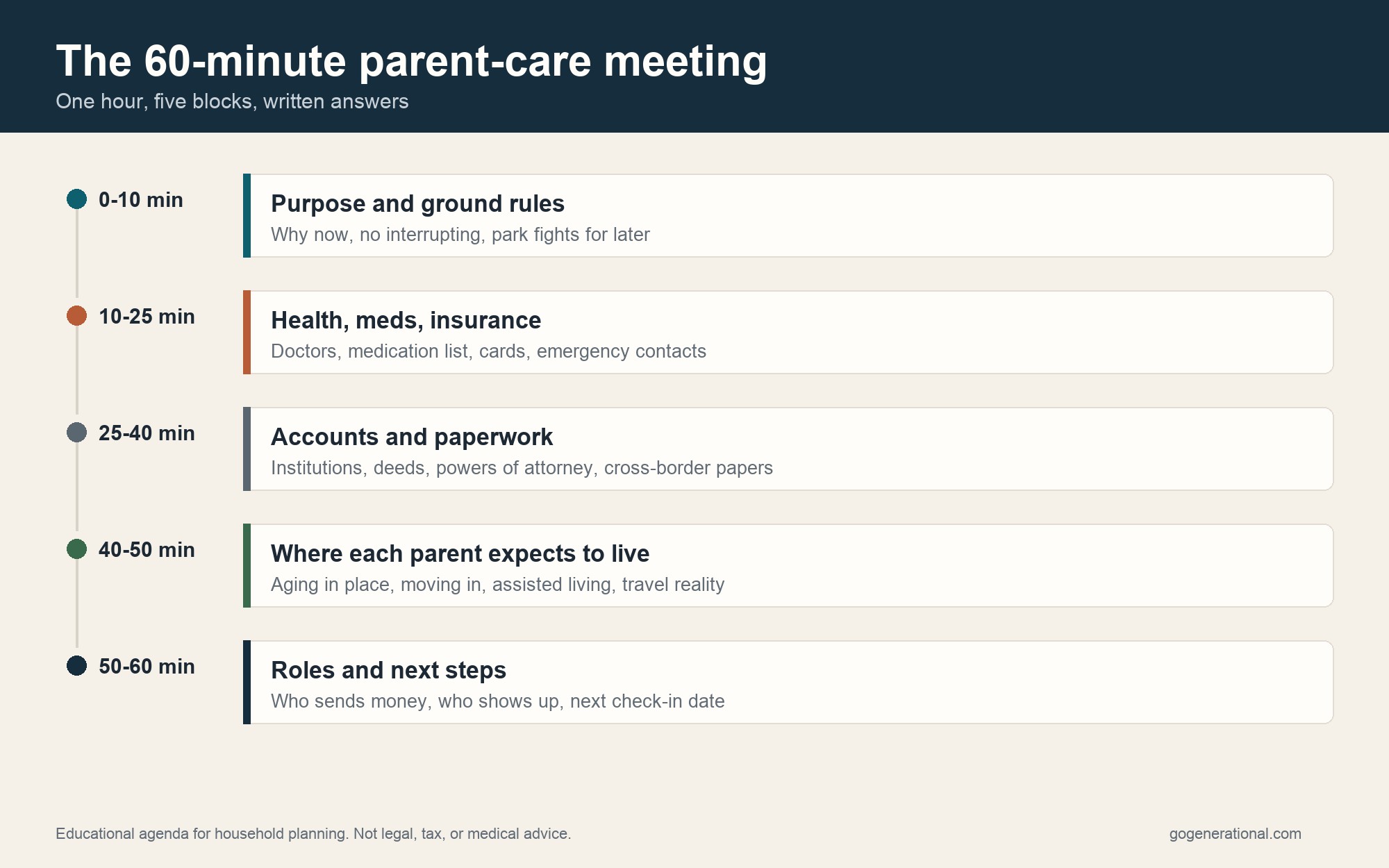
The agenda itself fits on one screen. Minutes 0 to 10 for purpose and ground rules. Minutes 10 to 25 for health, medication, and insurance cards. Minutes 25 to 40 for accounts, property, and legal authority. Minutes 40 to 50 for housing and travel reality. Minutes 50 to 60 for roles, next steps, and the date of a short follow-up. Afterward, save the note the same day, scan whatever was missing within two weeks, and run the cash scenarios in a calculator rather than in a group chat.
Keep the rest of the system nearby. What Documents to Organize for Aging Immigrant Parents and Medicare and Medicaid Paperwork Barriers for Limited-English Parents cover the file itself. Long-Distance Parent Care Coordination for Diaspora Adults handles the version where the family is spread across cities, and How Much Should You Help Your Parents Financially keeps duty from becoming an open tab. Test costs in the Parent Care Cost Planner and the monthly ceiling in the Family Support Budget Calculator. For why this hour matters now, pair it with Caregiving Is Delaying Long-Term Financial Security Across Asian Households.
This is educational household planning, not legal, tax, or medical advice. State rules, immigration status, and plan documents decide what actually works, so bring in an elder-law attorney, a fee-only planner, or a clinician who knows the family when balances are large or a parent’s capacity is changing. One hour will not settle every question in every corridor. It does mean the next emergency is not the first time anyone asked.
Related content
Further diaspora reading
- Caregiving Is Delaying Long-Term Financial Security Across Asian Households (Generational)
- The parent-support budget: how to help without quietly sacrificing your own retirement (Generational)
- What Documents to Organize for Aging Immigrant Parents (Generational)
- How to Split Parent Support Between Siblings (Generational)
- Highs and Lows of Asian Multi-Generational Living (Goldsea)
Generational Take
Get the next Generational Take
Get our latest practical tips and takes in your inbox. No spam.