
Caregiving Is Delaying Long-Term Financial Security Across Asian Households
Nearly nine in ten Asian adults want late-life independence, and only 19% plan to lean on their children. Six in ten caregivers say family duty is already denting their own security. For diaspora families, “I won’t burden you” still needs a plan.
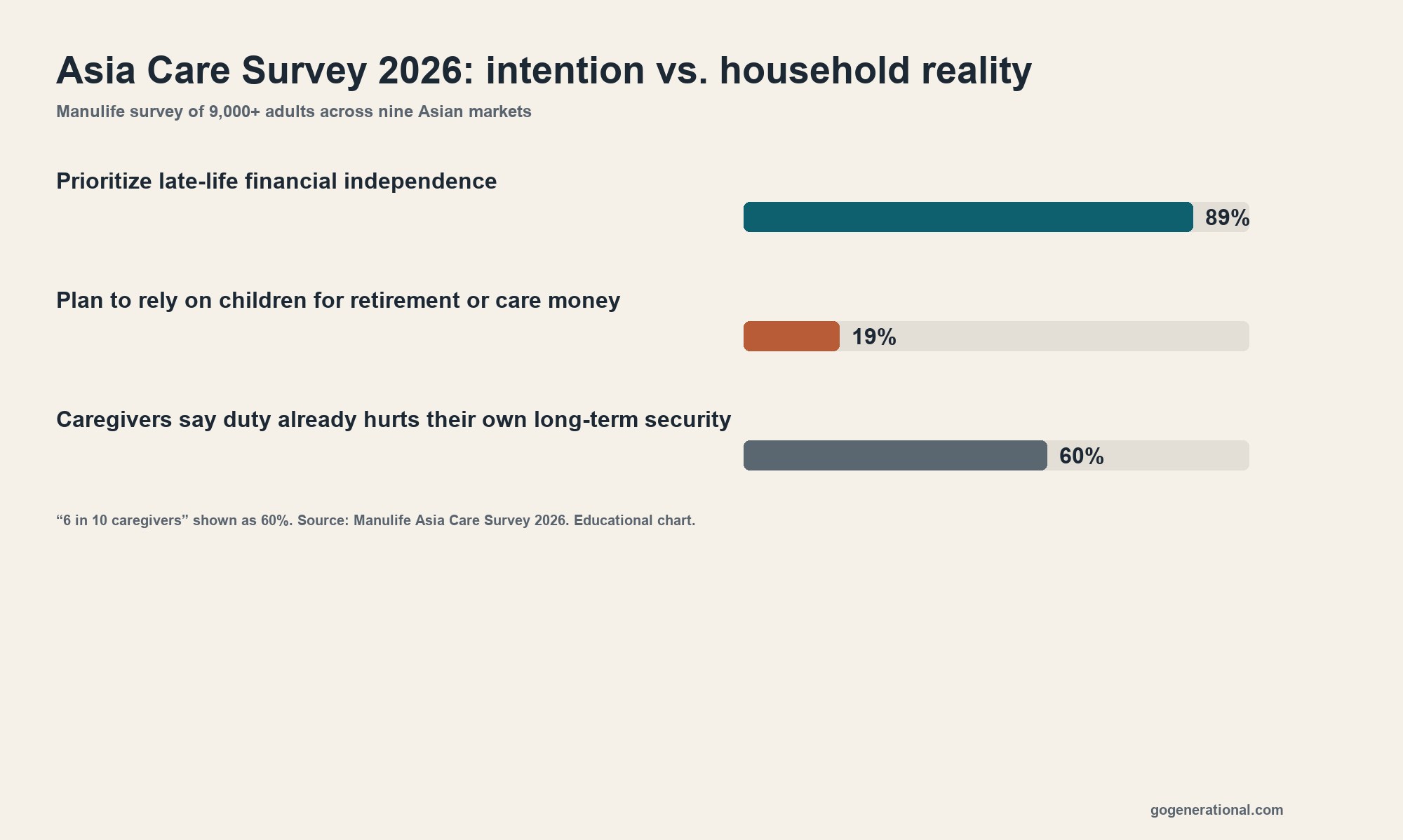
Nearly nine in ten adults across Asia say they intend to fund their own old age. Only 19 percent expect to lean on their children for retirement or care money. Ask the children, and a version of that bill is already arriving.
Those figures come from the Manulife Asia Care Survey 2026, fielded online in February and March among more than 9,000 adults age 18 and older in nine markets: the Chinese Mainland, Hong Kong, Taiwan, Japan, Singapore, Malaysia, Indonesia, the Philippines, and Vietnam. Manulife is the Toronto-headquartered insurer and asset manager that operates as John Hancock in the United States.
The respondents live in Asia, not the U.S., so the survey is best read as a measure of parental intent rather than a portrait of American households. The script will sound familiar in diaspora homes anyway. A parent insists they will never be a burden, while an adult child quietly covers the pharmacy run, the rent gap, and the flights.
On intent, the numbers are unusually clean. Eighty-nine percent prioritize financial independence and self-sufficiency for as long as possible. More than 80 percent say independence matters more than passing on wealth. Respondents earmark about 68 percent of their financial assets toward funding their own later years, against 32 percent set aside for inheritance. Steve Finch, chief executive of Manulife Asia, describes independence as “the new and better legacy.”
That amounts to a quiet repricing of the family balance sheet. The inheritance many first-gen households were raised to expect is shrinking on purpose, and the self-funded care pool is growing. The promise only holds if the money behind it can go the distance.
Respondents put the late-life stretch when they may need care or financial support at roughly 13 to 14 years. That is where intent starts to thin. Only 51 percent are using investments to fund retirement and care needs, a share that falls to 43 percent in Vietnam, 40 percent in the Chinese Mainland, and 30 percent in Japan. Fabio Fontainha, who runs Manulife’s wealth and asset management business in Asia, called it a clear disconnect between what people want and how they are acting.
Cash-heavy caution is not irrational for households that lived through currency shocks and thin pensions. It is just a hard way to fund fourteen years of care costs.
Work is doing some of the lifting instead. Seventy-four percent expect to keep working past 65, most hoping for flexible part-time arrangements, though 39 percent in the Chinese Mainland and 32 percent in Japan would rather stay full-time. Independence, in practice, is being financed partly by not retiring.
About half of all respondents already provide care or money to family, and six in ten of those caregivers say the responsibility is eroding their own long-term health and financial security. The strain is heaviest on the sandwich generation, supporting children and parents at once. In diaspora households the work rarely carries the word caregiver. It looks like remittances, refill runs, translating at appointments, and whichever sibling lives closest becoming the unpaid case manager.
U.S. evidence points the same direction. The Employee Benefit Research Institute, the Washington nonprofit that has studied workplace benefits since 1978, reported in July that one in five working unpaid caregivers had taken on new debt and 19 percent had cut retirement-plan contributions. Pew Research Center puts the share of Asian American adults sending money to an ancestral homeland near 27 percent, most often for everyday living costs and health care. None of that requires a resignation letter to show up in a retirement balance.
Which is the trouble with “I won’t burden you.” It is a generous sentiment and a weak plan. A parent can mean every word and still leave an adult child holding the appointment calendar, the clinic portal, the wire transfer, and the visa clock. Manulife’s own data argues for talking earlier: close to 70 percent believe early conversations about aging and care lead to better wellbeing later, yet more than 40 percent have never had one, usually because nobody knows how to start.
For diaspora families, the unsaid part is usually housing, insurance, and geography. A parent aging in a flat in Manila, moving into a spare room in New Jersey, or entering assisted living near a sibling in California produces three different budgets. CareScout, the Genworth research arm behind the long-running Cost of Care survey, put the 2025 U.S. national median for assisted living near $6,200 a month before local premiums.
Coverage is its own project. Medicare does not extend to a parent as a dependent, and permanent residents generally need years of U.S. residence and work credits, or a premium buy-in, before they qualify. Distance complicates the rest. AARP and the National Alliance for Caregiving counted roughly 63 million U.S. caregivers in their 2025 report, with more than one in ten living at least an hour away. Duty does not shrink with mileage. It converts into airfare, telehealth logins, and a cousin who can drive to dialysis.
Four questions are worth answering before a hospital visit answers them for you. Where does each parent want to live if mobility or memory changes, and what would that cost? Which accounts, property titles, and cross-border documents exist, and who can legally act if a parent cannot?
Then the two nobody volunteers. What support is already flowing each month as remittances, rent help, or unpaid hours, and which sibling owns which piece? And which of your own goals, from the employer match to a down payment, has already slipped, with what date to restart it?
For the one-hour version of that conversation, read The 60-Minute Parent-Care Meeting Every Diaspora Family Should Have, then work the file with What Documents to Organize for Aging Immigrant Parents and Long-Distance Parent Care Coordination for Diaspora Adults. Keep the cash visible with How Much Should You Help Your Parents Financially, Caregiver Costs and Retirement Delay Benchmarks for Employed Adult Children, and How to Plan Remittances Without Derailing Retirement. Run the monthly numbers through the Family Support Budget Calculator and care scenarios through the Parent Care Cost Planner.
Manulife sells insurance and investments, so treat this as sponsored research and educational context rather than a forecast for your family. Corridor, sibling map, and immigration status decide the local math. What travels is the finding underneath the press release: parents across Asia are planning for independence, their children are already paying for the transition, and usually only one of those two facts gets said out loud at dinner.
Related content
Further diaspora reading
- One in five working caregivers has taken on debt. The retirement damage starts before anyone quits a job. (Generational)
- The parent-support budget: how to help without quietly sacrificing your own retirement (Generational)
- The 60-Minute Parent-Care Meeting Every Diaspora Family Should Have (Generational)
- How Much Should You Help Your Parents Financially (Generational)
- Highs and Lows of Asian Multi-Generational Living (Goldsea)
Generational Take
Get the next Generational Take
Get our latest practical tips and takes in your inbox. No spam.