
One in five working caregivers has taken on debt. The retirement damage starts before anyone quits a job.
One in five working unpaid caregivers has taken on new debt, and a third send cash to the person they care for. For diaspora households, remittances and co-residence can hide that strain inside ordinary family duty.
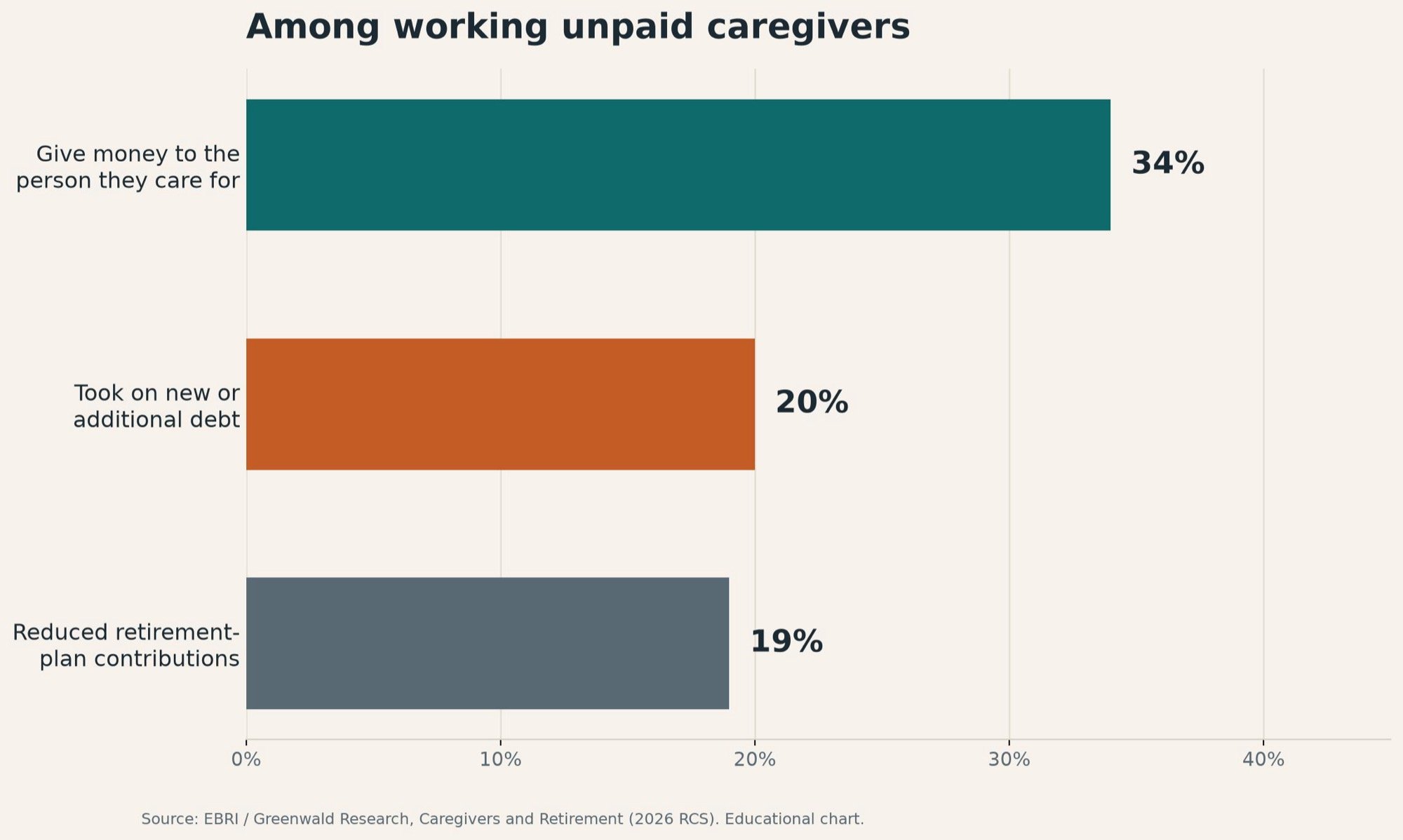
One in five working unpaid caregivers has taken on new or additional debt because of caregiving. A third give money to the person they care for. Neither number requires a resignation letter. The retirement damage can start while the job title stays the same.
That finding comes from a July 2026 Employee Benefit Research Institute Issue Brief built on the 2026 Retirement Confidence Survey, fielded with Greenwald Research in January. EBRI is the Washington nonprofit that has studied employee benefits since 1978. Greenwald Research is the health-and-wealth survey firm that co-runs the RCS, now in its 36th year. Nearly three in ten adults age 25 or older met the survey’s caregiver definition: unpaid help for an adult or child in a noninstitutional setting over the prior year, with help on at least one daily living or household task such as shopping, meals, housework, or transportation.
Among caregiving workers, 34 percent said they provided financial support to the person receiving care. Twenty percent said they took on new or additional debt as a result of caregiving. Nearly one in four borrowed from family or friends, and 19 percent reduced what they contributed to a retirement savings plan. Forty-one percent of caregiving workers said they did none of those actions. The split is useful. Many households absorb the hours without a credit-card spiral. The ones who did take on debt or cut contributions still need a clearer label for what is happening.
For diaspora households, that label is the hard part. Remittances, co-residence, and “just helping Mom with the pharmacy run” can look like ordinary filial duty rather than caregiving finance. Pew Research Center, the nonpartisan polling shop, has found about 27 percent of Asian American adults sent money to someone in an ancestral homeland in a recent survey year, often for living costs and health expenses. About a quarter of Asian Americans live in multigenerational homes, roughly double the share of White Americans in Pew’s 2021 reading. When cash, rent, and hours share one roof, the monthly wire and the caregiver debt can feel like the same story with different receipts.
The national balance sheet around those caregivers is already thinner. Thirty-four percent of caregivers overall had less than $10,000 in savings and investments, compared with 25 percent of non-caregivers. Sixty-nine percent said debt was a problem, versus 57 percent. Even among households earning $75,000 or more, 32 percent of caregivers said they were not confident they would have enough money throughout retirement, compared with 23 percent of non-caregivers in the same income band. A good salary can hide the squeeze. It does not erase it.
Older surveys point the same direction. AARP and the National Alliance for Caregiving’s Caregiving in the U.S. 2020 report found 28 percent of caregivers had stopped saving and 23 percent had taken on more debt, with adult care lasting about 4.5 years on average. AARP’s 2021 out-of-pocket cost study put Asian American and Pacific Islander caregivers’ average annual spending near $8,368, about 22 percent of income in that sample. Different surveys, different years. Care money still leaves before compounding can work.
Mental load travels with the money. Sixty-four percent of caregiving workers in the EBRI brief said caregiving negatively affected their mental health. Fifty-six percent said it hurt emergency saving, and 54 percent said it hurt working the hours they want or need. That is how debt shows up without a dramatic exit: fewer overtime hours, a thinner buffer, a clinic bill on a card, a remittance that cannot wait for payday. Quitting is one retirement event. Living on revolving credit while still employed is another.
Proposed federal help is still mostly a headline. Versions of the Credit for Caring Act would create a working-caregiver tax credit, but as of 2026 that credit is not law. Some states have their own caregiver tax programs. Treat any national credit as a watch list, not a budget line you can spend today.
The practical move is to make the blur visible. Name remittances, parent cash support, and care out-of-pocket costs as budget lines beside rent and retirement. Set a temporary ceiling with a review date. If you cut a 401(k) deferral or add card debt for care, write the restart conditions the way you would a leave policy. Ask benefits about emergency savings, caregiver leave, or backup care before a 401(k) loan becomes the default buffer. Ask siblings to split money, time, and paperwork out loud so one local adult child is not financing everyone else’s good intentions.
For the full system, including match protection and a three-account ceiling, read The parent-support budget: how to help without quietly sacrificing your own retirement. Use Caregiver Costs and Retirement Delay Benchmarks for Employed Adult Children and Parent Care Cost Benchmarks for Diaspora Adult Children for the cash and hours math. How to Plan Remittances Without Derailing Retirement and How Much Should You Help Your Parents Financially keep duty from becoming an open tab. Cap support against savings with 401(k) Contribution Rate Benchmarks with Family Support Caps, then run the monthly picture through the Family Support Budget Calculator and the Parent Care Cost Planner.
EBRI’s numbers are educational context from a national survey, not a personalized debt diagnosis. Your interest rates, visa status, parents’ location, and sibling map are local. The useful warning is simpler than the chart: retirement damage does not wait for a goodbye party at work. It can start the month the card balance and the family wire become the same paycheck problem.
Related content
Further diaspora reading
- The parent-support budget: how to help without quietly sacrificing your own retirement (Generational)
- Family Caregivers Aren’t Only Spending Money. They’re Losing Years of Retirement Savings (Generational)
- How to Plan Remittances Without Derailing Retirement (Generational)
- How Much Should You Help Your Parents Financially (Generational)
- Highs and Lows of Asian Multi-Generational Living (Goldsea)
Generational Take
Get the next Generational Take
Get our latest practical tips and takes in your inbox. No spam.