
The parent-support budget: how to help without quietly sacrificing your own retirement
Write the true monthly cost of helping parents, keep emergencies off the recurring line, protect the employer match, and run three payday accounts under an annual ceiling.
The wire lands before the 401(k) contribution does. The pharmacy run becomes a habit. A sibling says they will “chip in later.” Six months later the match is half-funded and nobody can say what parent support actually costs.
A parent-support budget is the fix for that blur: a written system for the true monthly commitment, a hard line between emergencies and recurring help, sibling cost-sharing, smarter payment paths, a protected employer match, tax tools only when they fit, an annual ceiling, and a three-account setup you can run on payday. It is how you keep helping without turning duty into an open tab on your future.
National numbers explain why the system matters. The Employee Benefit Research Institute’s July 2026 caregivers brief, built on the Retirement Confidence Survey with Greenwald Research, found that 34 percent of working unpaid caregivers give money to the person they care for, 20 percent take on new or additional debt, and 19 percent reduce retirement-plan contributions. For diaspora households, those lines often hide inside remittances and co-residence that feel like ordinary family life.
Pew Research Center has found about 27 percent of Asian American adults sent remittances to an ancestral homeland in a recent survey year, often for ordinary living costs and health. AARP’s 2021 out-of-pocket study put Asian American and Pacific Islander caregivers near $8,368 a year on average. Duty can look ordinary. The spreadsheet still needs a total.
Start with the true monthly commitment. Add every recurring dollar: rent or condo gaps, remittances, groceries you buy for parents, aide hours you fund, insurance premiums you cover, and travel you take every quarter amortized into a monthly figure. If you want a sibling conversation that is not a fight, add a light estimate of unpaid hours at a local home-aide rate. Divide the cash total by monthly take-home pay after taxes.
The Bureau of Labor Statistics puts average U.S. cash contributions near $2,378 a year, about 3 percent of household spending in 2023. Diaspora remittance households often sit higher than that national baseline. That is fine. You still need a percent you can see. Generational’s planning bands treat under 15 percent of take-home as a green review zone when the employer match and emergency fund still hold, 15 to 20 percent as yellow, 20 to 25 percent as orange for sibling or partner alignment, and above 25 percent as a red baseline that needs a timeline to lower or share. At $8,000 take-home, those markers are about $1,200, $1,600, and $2,000 a month. They are conversation zones, not moral verdicts or legal limits.
Separate emergencies from recurring support next. A hospital bill and a monthly rent gap are different animals. If the crisis month becomes the new permanent wire, retirement is what shrinks. Keep a recurring line for the baseline you can sustain, a health-and-spike reserve for medical and care shocks, and an episodic fund for travel, ceremonies, and home repairs. EBRI’s finding that one in five working caregivers took on new debt is often the story of a spike that never got its own account.
Sibling cost-sharing belongs on the same page. Fair rarely means equal dollars. One sibling may earn more; another may live ten minutes from the clinic; a third may own the remittance and paperwork. Common models include income-proportional cash, time-for-money credits when local hours replace a paid aide, and category ownership where one person covers prescriptions and another covers rent. Write the roles, the monthly cash each person sends, and a quarterly review date. Silence is how one local adult child finances everyone else’s good intentions.
Payment method is part of the budget, not a detail. Cash and remittance apps are simple, but they usually count toward the IRS annual gift exclusion, which is $19,000 per recipient in 2026 for most people. Paying a medical provider or school directly for qualifying tuition can sit outside that annual gift limit under IRS gift-tax rules. Direct medical payments can also make it easier to track expenses that might belong on a Schedule A medical deduction if you itemize and clear the 7.5 percent of adjusted gross income threshold in IRS Publication 502. Remittances still matter for parents abroad who need flexible cash. Choose the path on purpose: cash for living costs, direct pay when a bill is medical or tuition and the paperwork helps.
Protect the employer match before you raise the send. Fidelity’s educational guidance frames about 15 percent of pre-tax income, including any employer contribution, as a common retirement savings anchor. The first slice of that story is usually the match formula itself. Skipping a 50 percent match on the first 6 percent of pay to free an extra $200 for family is often a guaranteed loss larger than the wire “saves.” Confirm whether your plan true-ups the match at year-end. If it does not, spread deferrals across paychecks so you do not max early and miss later match dollars. Treat full match capture as a floor that family support cannot quietly erase.
Tax provisions help only when the facts fit. A dependent care flexible spending account, sometimes called a DCAP, can use pre-tax dollars for qualifying care so you can work. For 2026, federal law raised the exclusion limit to $7,500 for many filers, but only if your employer amends the plan. IRS Publication 503 generally requires that an adult parent live with you more than half the year and be unable to care for themselves. A parent in their own home or a facility usually will not qualify for that FSA or the related Child and Dependent Care Credit on Form 2441.
A health FSA, with a 2026 employee salary-reduction limit of $3,400 under IRS Revenue Procedure 2025-32, may cover qualifying medical costs when plan and dependency rules allow. None of these breaks are automatic. Ask benefits and a tax professional before you enroll against a parent-care plan the forms will not support.
Set an annual ceiling in writing. Multiply recurring by twelve, add the year’s planned episodic calendar, and add what you intend to deposit into the spike reserve. That sum is the parent-support budget. Share it with a partner. Share the cash plan with siblings. Put a review on the calendar after raises, rent changes, or a new diagnosis. If you cut a 401(k) deferral or add card debt for care, write the restart conditions the way you would a leave policy. EBRI’s debt finding is a warning about open-ended months, not about helping.
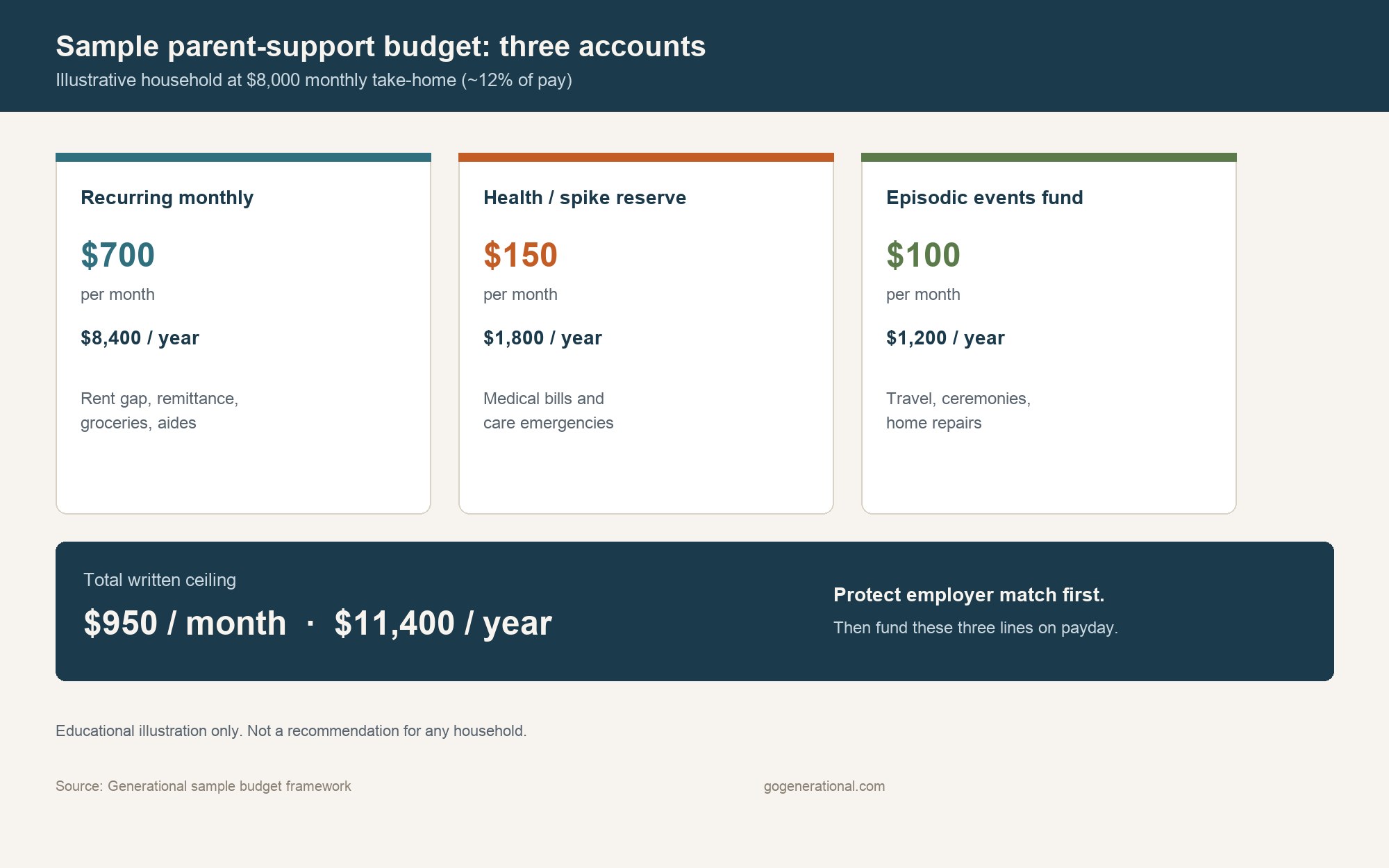
A sample three-account system makes the ceiling tangible. Take an illustrative household at $8,000 monthly take-home. After capturing a full employer match on a $110,000 salary, fund three automated transfers on payday: $700 to a recurring parent-support account for rent, remittances, and routine help; $150 to a health-and-spike reserve; and $100 to an episodic events fund for flights and one-off repairs. That is $950 a month, or $11,400 a year, about 12 percent of take-home. The numbers are a teaching sample, not a prescription. Your corridor, sibling map, and rent will rewrite them. The structure travels.
Run your real picture through the Family Support Budget Calculator and care scenarios through the Parent Care Cost Planner. Dig into percents and caps with How Much Family Support Is Too Much by Income Percent? and Recurring vs Episodic Support Caps on One Household Budget. For roles and match math, use How to Split Parent Support Between Siblings, 401(k) Contribution Rate Benchmarks with Family Support Caps, and How to Plan Remittances Without Derailing Retirement. Pair the system with today’s EBRI debt read at One in five working caregivers has taken on debt.
Helping your parents and funding your own retirement belong on the same household plan when the dollars have names. Write the monthly commitment, keep emergencies from rewriting the baseline, share the load out loud, pay the right bills the right way, protect the match, use tax tools only when they apply, and live inside an annual ceiling you can defend at the next family call. That is a parent-support budget worth keeping.
Related content
Guides
- How Much Should You Help Your Parents Financially?
- How Much Family Support Is Too Much by Income Percent?
- Recurring vs Episodic Support Caps on One Household Budget
- How to Split Parent Support Between Siblings
- 401(k) Contribution Rate Benchmarks With Family Support Caps
- How to Plan Remittances Without Derailing Retirement
Further diaspora reading
- One in five working caregivers has taken on debt. The retirement damage starts before anyone quits a job. (Generational)
- How Much Family Support Is Too Much by Income Percent? (Generational)
- How to Split Parent Support Between Siblings (Generational)
- 401(k) Contribution Rate Benchmarks with Family Support Caps (Generational)
- Highs and Lows of Asian Multi-Generational Living (Goldsea)
Generational Take
Get the next Generational Take
Get our latest practical tips and takes in your inbox. No spam.