
68% of 401(k) savers feel on track. Their balances may buy only half the income they expect.
BlackRock’s 2026 Read on Retirement finds confidence rising while projected workplace balances cover about 50 to 60% of the income savers expect those accounts to deliver. For diaspora households, remittances and parent care are the capacity squeeze behind the gap.
Nearly seven in ten workplace savers say they are on track for the retirement lifestyle they want. BlackRock’s 2026 Read on Retirement survey puts that share at 68 percent, and employers are almost as bullish: 66 percent believe most of their workers are headed the same way. Then the firm runs the balances forward. Projected workplace accounts cover only about 50 to 60 percent of the annual income those savers expect those accounts to produce.
BlackRock is the New York asset manager that oversees trillions for pensions, 401(k)s, and individual investors, and that pioneered target-date funds under its LifePath brand. Read on Retirement is its eleventh annual pulse of people already inside employer plans. Escalent, an independent research firm, fielded the 2026 wave in April and May among 1,312 full-time 401(k) or 403(b) participants with at least $5,000 in their current account, plus 300 retirees and 453 plan sponsors. Confidence can ride a strong market. The income projection is the harder check.
Jaime Magyera, BlackRock’s head of retirement and head of U.S. wealth advisory, framed the gap plainly when the report landed in late June: confidence is growing, but for too many Americans retirement reality will not match retirement expectations. Bridging that gap, she said, means helping savings work harder and turning them into reliable income that lasts. Put another way, a rising balance on your quarterly statement can feel like progress while still funding a thinner paycheck than the one you are imagining at 65.
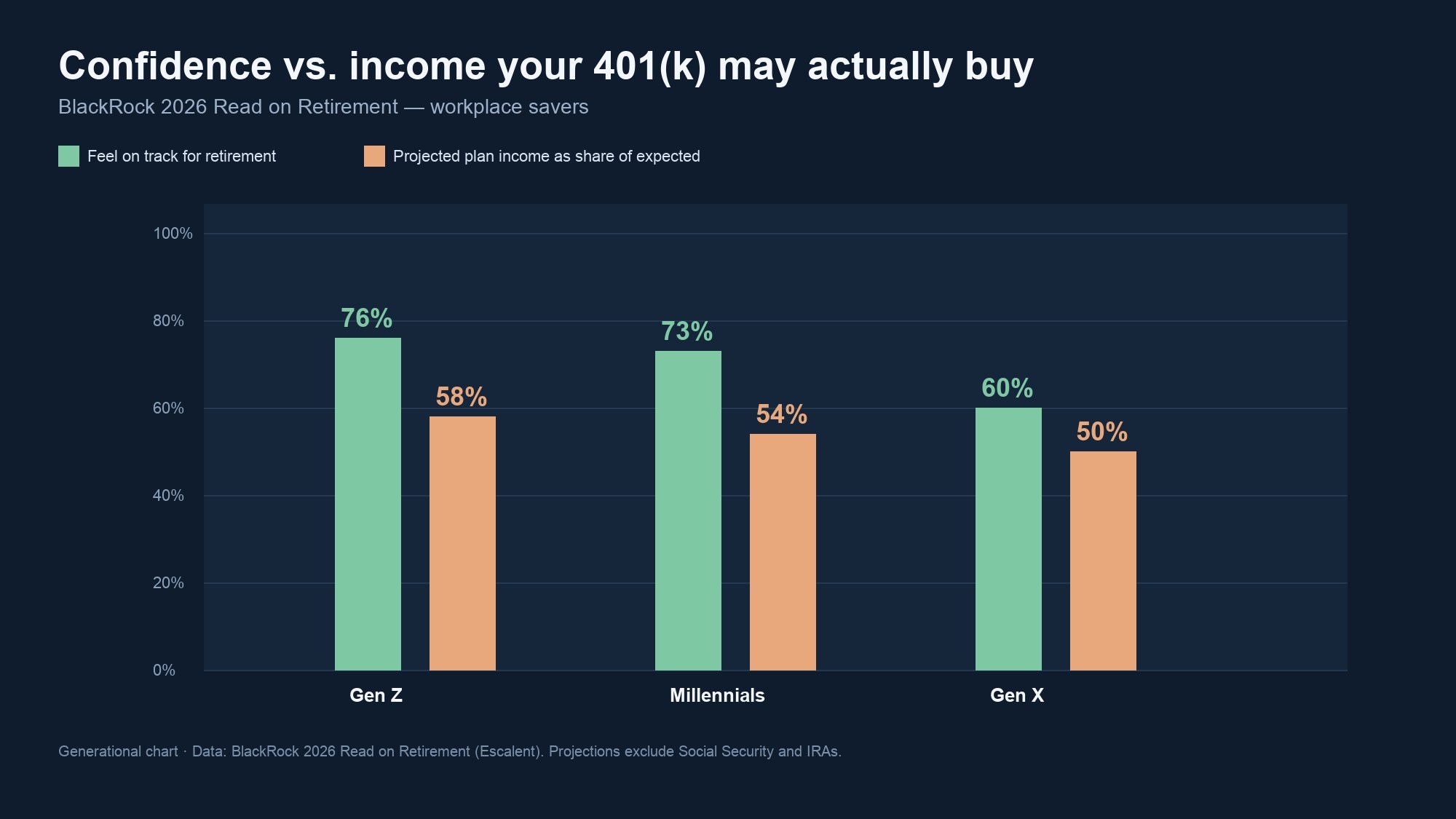
The gap shows up differently by age. Gen Z participants are the most confident, at 76 percent, yet BlackRock’s projections cover about 58 percent of the plan income they expect. Millennials sit at 73 percent confidence with roughly 54 percent income coverage, and Gen X, closest to the exit, is least confident at 60 percent with coverage near half. Under the firm’s assumptions, including a retirement age of 65, illustrative projected balances run about $650,000 for Gen Z, $541,000 for millennials, and $404,000 for Gen X. Those are model paths, not promises. They still explain why a six-figure screenshot can sit next to a shortfall story.
Nick Nefouse, BlackRock’s global head of retirement solutions and head of LifePath, has described the method in industry coverage: take current balances and savings rates, apply the firm’s capital-market assumptions to retirement, then convert the lump sum into spending. The analysis leaves out Social Security, IRAs, pensions, and home equity. That caveat cuts both ways. Some households close part of the gap with those other pillars. Remittance and caregiving households often have thinner outside pillars, so the workplace account is doing more of the work than a 401(k)-only model can show.
Capacity is the word BlackRock keeps using, and it fits diaspora kitchens better than a lecture about awareness. Participants say they need to contribute about 15 percent of pay to retire with the lifestyle they want. The median contribution in the sample is 10 percent. More than half expect they may need to contribute less over the next twelve months because living costs, family support, and loan payments are competing for the same paycheck. About 43 percent of surveyed savers identify as caregivers. When the raise arrives, the remittance, the parent’s clinic bill, or a sibling’s ask often claims it before the deferral does.
Pew Research has found about 27 percent of Asian American adults sent money to someone in an ancestral homeland in a recent survey year, often for ordinary living costs and health expenses. Older Prudential research put financial help to relatives at about one in five Asian Americans, roughly three times the general-population rate it reported. Those patterns turn “competing financial priorities” from a survey checkbox into a monthly wire. The 401(k) match is still free money. Skipping it to keep a parent whole is love with compound interest attached.
Savers know the longevity risk in their bones. Sixty-four percent worry about outliving their savings. Seventy-six percent say their generation will have less certainty of retirement income than earlier ones, a series high in BlackRock’s tracking. Nine in ten want secure income options inside the workplace plan. Retirees in the sample are even blunter: most say guaranteed income through a plan would have helped, and many say it mattered more than they expected. That demand is why sponsors are shopping “personal pension” features, from in-plan income riders to richer target-date designs, not only higher match formulas.
Interest is also rising in active target-date funds, private-market sleeves, and AI-assisted guidance. Among savers with a preference, 55 percent prefer actively managed target-date funds over index versions. About three in four participants are interested in private-market access through the plan, and 45 percent of sponsors are considering private exposure, up sharply from the prior year. More than half of savers want AI-assisted retirement guidance, and about one in four sponsors already use AI-generated outreach. Treat those findings as a map of what plans may add, not a shopping list. Fees, liquidity, and fiduciary process still matter, and the Department of Labor’s March 2026 proposed safe harbor for selecting plan investments is still a proposal, not a finished rulebook.
For first-gen and immigrant-household professionals, the practical read is narrower than BlackRock’s product menu. Open your plan’s income or “paycheck” estimator if it has one, and write down a monthly number beside Social Security estimates instead of staring at a lump sum. Confirm you capture the full employer match before any discretionary bump in family sends. Put remittances and parent care in named budget lines so the deferral is not whatever is left after guilt. If you are already caregiving, treat contribution pauses as a temporary policy with a restart date, not a personality trait. Ask benefits whether the plan offers in-plan income options, emergency savings, or advice tools, and what they cost.
Use First-Gen Retirement Planning Basics and Retirement Planning When Your Parents Did Not Have a 401(k) to reset the runway. How to Plan Remittances Without Derailing Retirement and 401(k) Contribution Rate Benchmarks with Family Support Caps keep family money from silently picking your deferral. Caregiving drag belongs in Caregiver Costs and Retirement Delay Benchmarks for Employed Adult Children. Run the monthly picture through the Family Support Budget Calculator and care scenarios through the Parent Care Cost Planner.
Treat BlackRock’s findings as educational context from people who already have workplace plans, not a personalized forecast. Markets, taxes, health, and family obligations move. When the gap between the life you want and the income your balances can buy feels wide, a fee-only planner or your plan’s advice channel can stress-test the numbers without selling you a slogan.
Feeling on track is a mood markets can inflate. Income is the number that pays the rent at 70. The households that close more of the BlackRock gap treat family support as a budget line with a ceiling, and treat the 401(k) as a paycheck they are building for a future self who still has parents, siblings, and a longer life to fund.
Related content
Further diaspora reading
- Three in four employers now call retirement a top priority. AI may mainly show who cannot leave. (Generational)
- Americans hope to live to 91. Only 13% feel on track to fund the life they want. (Generational)
- How to Plan Remittances Without Derailing Retirement (Generational)
- 401(k) Contribution Rate Benchmarks with Family Support Caps (Generational)
- What’s Behind Asian American Longevity? (Goldsea)
Generational Take
Get the next Generational Take
Get our latest practical tips and takes in your inbox. No spam.