
Three in four employers now call retirement a top priority. AI may mainly show who cannot leave.
WTW’s 2026 survey of 547 plan sponsors finds retirement savings ranked as a core or top total-rewards priority, with 79% willing to use AI for plan analytics. For remittance and sandwich households, the open question is whether those dashboards improve support or simply flag workers who still cannot afford to retire.
Three in four U.S. employers now rank retirement savings as a core or top priority inside total rewards. That reading comes from the WTW 2026 Defined Contribution Survey, released August 3, 2026. WTW is a global advisory, broking, and solutions firm that surveys plan sponsors, the employers that offer and oversee workplace plans such as 401(k)s. The study asked 547 U.S. sponsors during mid-April through late May 2026, with a sample that skews toward large plans.
Priority is not the same as proof. WTW calls the shortfall a retirement outcomes gap: employers want plans to deliver timely, confident retirements, while many programs are still measured and governed for an earlier era of participation rates and account balances. Only 60 percent of sponsors even have a working definition of readiness. Among those that do, the definitions split across income replacement (40 percent), retiring on time (39 percent), and retirement confidence (39 percent). Sponsors could pick more than one.
For diaspora households, that gap already shows up at the kitchen table. A strong plan-average participation rate can hide the coworker who pauses contributions every time a parent’s hospital bill arrives, or who never raises the deferral because remittances already claim the raise. Aggregate dashboards love averages. Remittance and caregiving households live in the exceptions.
Chris West, WTW’s senior managing director and defined contribution strategy leader, framed the survey as a call to action: employers have invested heavily, and the next job is proving programs move people closer to readiness. Dave Amendola, managing director and intellectual capital and innovation leader for defined contribution strategy at WTW, put the worker-side problem in plain English. Headlines push a savings target. Even professionals struggle to say what the number means until it becomes a monthly lifestyle. Converting a balance into income is where confidence often breaks.
Sponsors say they feel that pressure. Over the next two years, enhancing the employee experience (69 percent) and improving retirement outcomes (63 percent) top their DC objectives. Half say the plan needs minor or moderate design updates. One in five want to hand off more administration and fiduciary delivery so internal teams can spend time on strategy. Three in ten plan to offer an in-plan retirement income solution, a tool meant to help savings become a paycheck rather than a lump sum workers stare at.
Delayed retirement is not only a personal story. When people cannot leave, workforce planning, succession, and talent costs stretch. That is why benefits leaders now talk about retirement as a business priority, not only a benefits brochure line. The survey also notes that sponsors often watch plan-level metrics and less often break results down by employee group, which is exactly where access, savings behavior, and outcomes diverge.
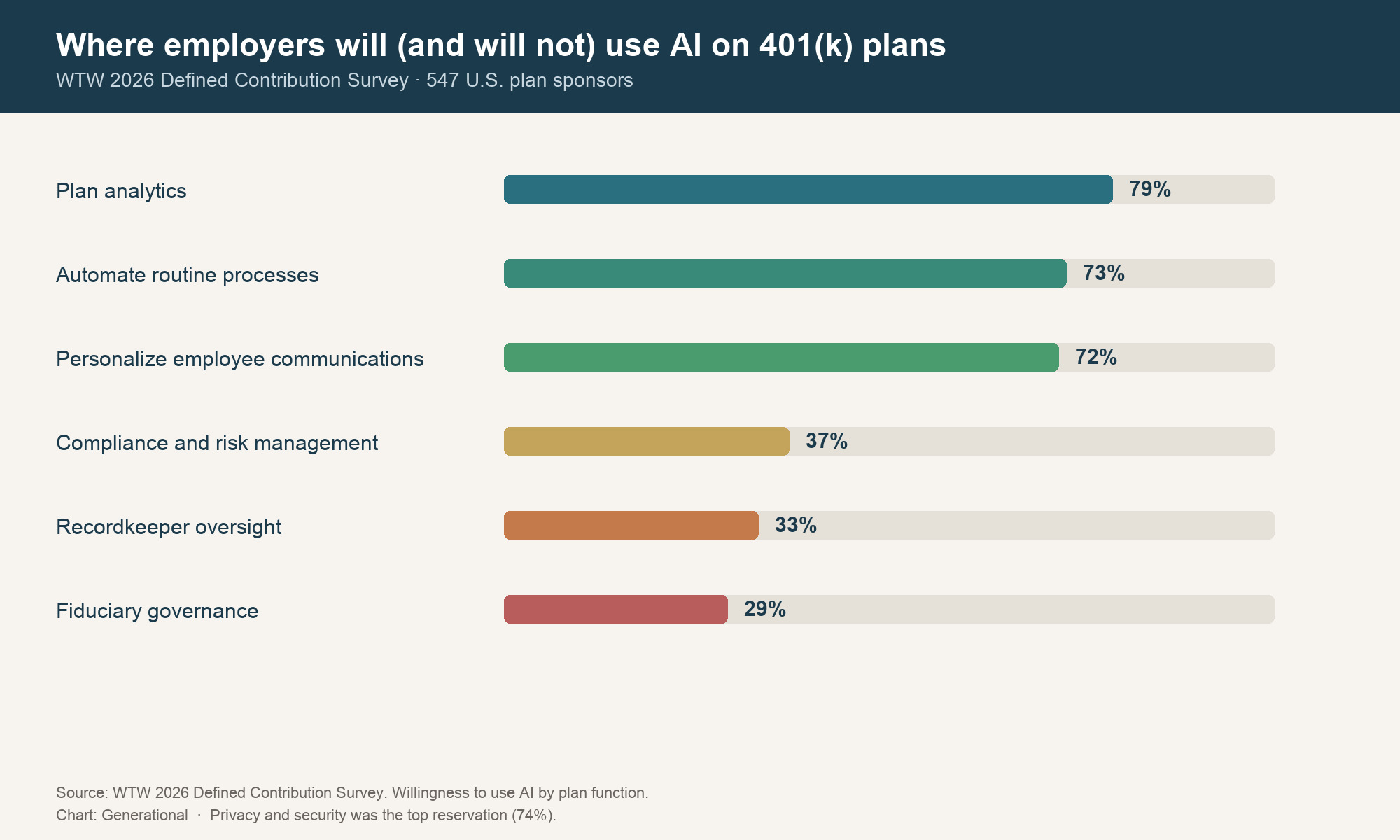
Artificial intelligence is the new chapter employers want to open, with clear limits. Nearly four in five sponsors (79 percent) are willing to use AI for plan analytics. Another 73 percent would use it to automate routine processes, and 72 percent to personalize employee communications. Willingness drops when the work touches harder accountability: 37 percent for compliance and risk management, 33 percent for recordkeeper oversight, and 29 percent for fiduciary governance. Data privacy and security is the top reservation, cited by 74 percent.
That pattern matters for anyone whose paycheck also funds family elsewhere. Analytics can surface low balances, irregular contributions, or late projected retirement ages. Those signals can trigger clearer match education, hardship counseling, income tools, or segmented outreach. They can also simply label remittance-heavy or caregiving workers as not ready, without changing match design, emergency access, or the transition support that still thins out right when people need to turn savings into income.
West’s public comment on AI stays in the constructive lane: sponsors are most comfortable where tools make programs more responsive, efficient, and insight-driven. The household question is who owns the insight. If AI only ranks who cannot afford to stop working, employers get a workforce-planning alert and workers get a colder dashboard. If AI helps sponsors see which design and support moves close gaps for real groups, including sandwich cohorts, the priority language starts to mean something.
Practical moves sit closer to the paycheck than to the survey PDF. Confirm you capture the full employer match before any discretionary raise in family sends. Cap remittances as a named budget line so the 401(k) deferral is not the silent residual. Ask benefits whether the plan offers in-plan income options, targeted counseling, or group-level readiness reports, and what privacy rules cover any AI-assisted outreach. If caregiving already cut hours or contributions, treat that as plan design context, not a personal failure.
For the longer map, First-Gen Retirement Planning Basics and Retirement Planning When Your Parents Did Not Have a 401(k) set the household frame. How to Plan Remittances Without Derailing Retirement and 401(k) Contribution Rate Benchmarks with Family Support Caps keep family money from quietly picking your deferral. Caregiving drag belongs in Caregiver Costs and Retirement Delay Benchmarks for Employed Adult Children. Run the monthly tradeoffs through the Family Support Budget Calculator.
Treat the numbers as household context from a large-sponsor survey, not advice for your plan’s fiduciary file. Definitions of readiness, AI pilots, and income tools will vary by employer. When balances, family support, and a retirement date collide, a fee-only planner or your plan’s advice channel can translate the dashboard into a decision you can live with.
Employers calling retirement a business priority is progress. The test is whether AI analytics become a better way to help people leave when they want to, or a sharper list of who still cannot.
Related content
Further diaspora reading
- Americans fear running out of money more than dying. (Generational)
- Family Caregivers Aren’t Only Spending Money. They’re Losing Years of Retirement Savings (Generational)
- How to Plan Remittances Without Derailing Retirement (Generational)
- 401(k) Contribution Rate Benchmarks with Family Support Caps (Generational)
- What’s Behind Asian American Longevity? (Goldsea)
Generational Take
Get the next Generational Take
Get our latest practical tips and takes in your inbox. No spam.