
Americans hope to live to 91. Only 13% feel on track to fund the life they want.
Guardian’s 2026 Mind, Body, and Wallet report finds a longevity gap: people imagine active decades past a conventional retirement while financial, physical, and mental preparedness lag. For diaspora households, longer lives and family support costs can stretch the same thin plan even further.
Americans say they would like to live to about age 91. U.S. life expectancy sits near 79. That twelve-year stretch is the opening tension in Guardian’s 2026 Mind, Body, and Wallet report, released May 5, 2026. Guardian is The Guardian Life Insurance Company of America, a mutual insurer that has tracked workplace well-being for fifteen years. The firm calls the mismatch a longevity gap: people are imagining longer, more active later years while mental, physical, and financial preparation still looks like a shorter retirement story.
Only 13 percent of working Americans in the study feel exactly on track to save enough for the retirement lifestyle they want. Nearly half (45 percent) say they are somewhat or very far off track. Financial health is the weakest pillar, with just three in ten rating it excellent or very good, tied at the lowest level Guardian has recorded. Self-reported strong mental health sits at 34 percent and strong physical health at 36 percent. Overall well-being and the company’s Workforce Well-Being Index are at multi-year lows.
The dreams attached to those extra years are specific. Sixty percent look forward to more free time, 55 percent to travel, and 52 percent to more time with family and friends. For 40 percent, aging well means staying physically active; 26 percent prioritize staying mentally sharp. Guardian’s survey of about 2,000 full-time workers finds most people still plan roughly two decades of full retirement, even as the average retirement age has risen about three years over the past three decades and the 65-and-older population has grown to 61.2 million people, about 18 percent of the country.
Andrew McMahon, Guardian’s chairman and CEO, put the gap in one line: Americans are living longer and envisioning fuller lives, but preparation is not keeping up. Erin Culek, head of financial protection and retirement solutions at Guardian, argues retirement planning has to do more than pile up a balance. As lives lengthen, she said, people need confidence and flexibility for whatever comes next, not only a savings target calibrated for a thinner span.
Wallet anxiety is already named. Half of working Americans say money is their top source of stress. Top retirement worries are having savings last as long as needed (41 percent), having a guaranteed income source (37 percent), and not saving enough (36 percent). Among workers 45 and older, 55 percent regret not starting sooner and 53 percent regret not saving enough. One-third say they do not have sufficient savings or investments to stop working. Estimates cited in the report put medical spending in retirement near $172,000, another reminder that living longer is not free even when Social Security and Medicare are in the picture.
Body and mind are part of the same ledger. Only 40 percent say they are good at keeping up with routine doctor visits, 31 percent at getting enough exercise, and 27 percent at eating a healthy diet. Thirty-four percent say they are good at taking care of their mental health. Gen Z and millennials trail boomers on some basics: 34 percent versus 59 percent say they are very good or excellent at routine appointments, and 29 percent versus 37 percent report a healthy diet. Cost shows up as skipped care. Nearly 19 percent of employees report avoiding doctor visits because of medical costs. Longevity without mobility or cognitive stamina is not the travel montage people say they want.
Planning paperwork for aging is thin too. Among Americans 45 and older, only 30 percent have a plan for where they will live later, 23 percent for who will care for them if they become ill or disabled, and 23 percent for making a home accessible. About a quarter say they have not even considered those questions. Just 18 percent of Americans under 65 often think about what life will be like in their 70s and beyond. The conventional retirement span still dominates the mental calendar, even when the wished-for birthday cake says 91.
Work is how many people bridge the gap, for better and worse reasons. Thirty-six percent of full-time workers expect to retire between 65 and 69. Two-thirds anticipate a retirement that includes some work: stopping a full-time career but continuing in another capacity, or shifting to part-time or consulting. Top reasons for working past 65 include wanting money for extras (41 percent), fearing boredom (39 percent), and seeking fulfillment (37 percent). Forty-three percent say they plan to work until health declines. Younger workers are more likely to picture a long, fully retired chapter: 20 percent of Gen Z and younger millennials say they are planning for 30 or more years of full retirement, versus 11 percent of Gen X.
Diaspora households feel an amplified version of the same math. CDC figures put Asian American life expectancy at birth near 85.2 years in 2023, higher than the national average. Extra years can be a gift. They can also mean more years of parent care, remittances, and sibling coordination before your own plan gets fully funded. Pew has found about one in four Asian American adults sending money abroad in a recent survey year, often for living costs and health expenses. A 401(k) contribution rate built for a 20-year retirement can buckle when the household is already funding someone else’s longevity.
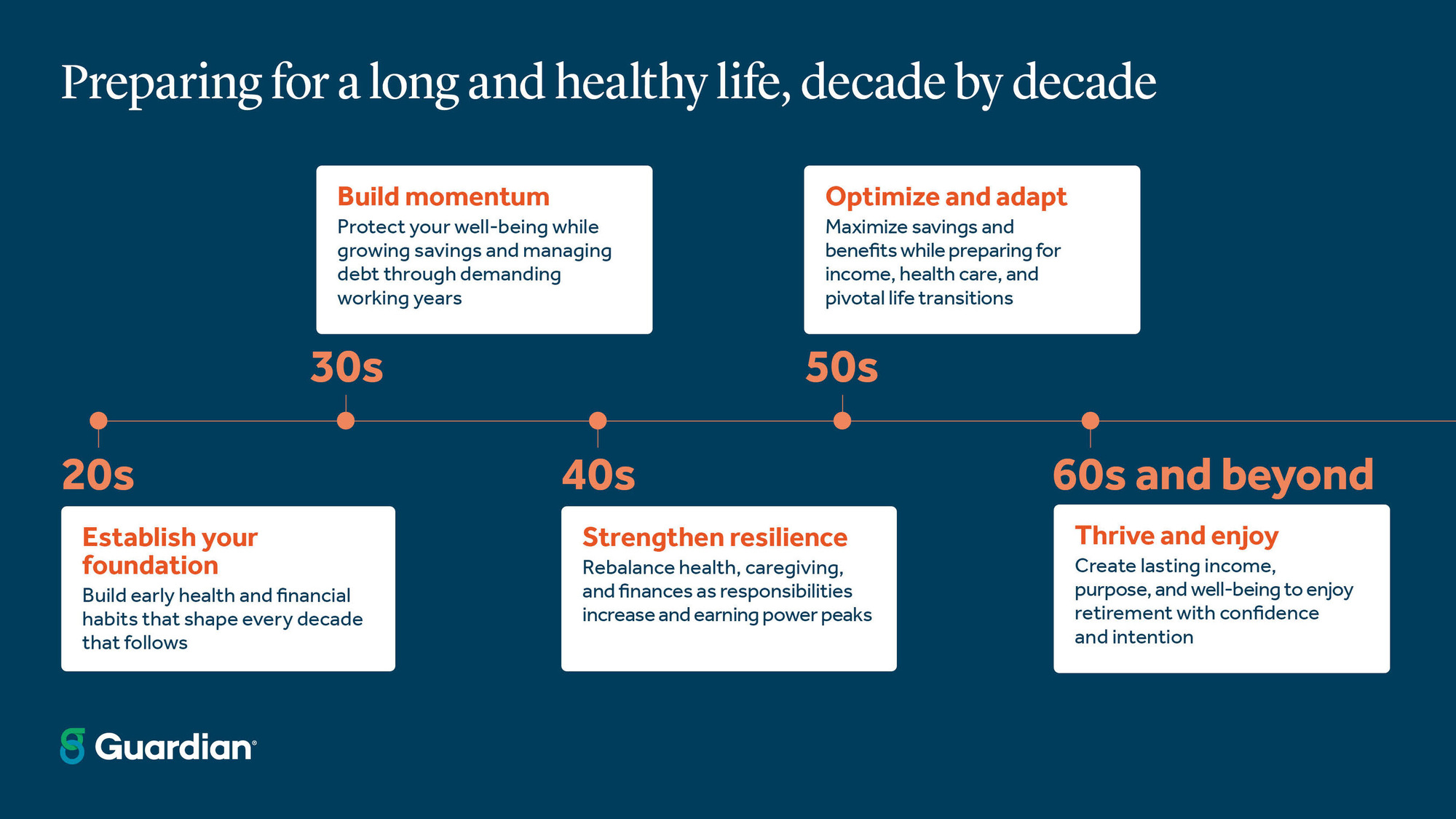
People who report high overall well-being in Guardian’s data share habits that look ordinary on purpose. Three-quarters say they are good at taking care of their mental health, 68 percent keep up with doctor appointments, and 61 percent work with a financial advisor. Among those with high financial wellness, 65 percent say they are very good at living within their means. The report’s decade-by-decade frame is blunt: foundations in the 20s, momentum in the 30s, caregiving and screenings in the 40s, catch-up savings and income tools in the 50s, purpose and Medicare literacy in the 60s. Longevity is not a problem you solve the year you leave work.
Practical moves stay concrete. Stretch your retirement income model past age 85, not only to 75, and write down what changes if you live to 91. Cap family support so remittances and parent care do not silently replace catch-up contributions. Book the screening you have been skipping; mobility and cognition are retirement assets too. Ask who would care for a parent, and for you, before a crisis assigns the job. If guaranteed income matters to your sleep, learn what your workplace annuity, pension, or Social Security claiming options actually do before you treat a target-date fund as the whole plan.
Use First-Gen Retirement Planning Basics and Retirement Planning When Your Parents Did Not Have a 401(k) to reset the runway. How to Plan Remittances Without Derailing Retirement and 401(k) Contribution Rate Benchmarks with Family Support Caps keep family money from eating the extra years. Caregiving drag belongs in Caregiver Costs and Retirement Delay Benchmarks for Employed Adult Children. Run the monthly picture through the Family Support Budget Calculator and care scenarios through the Parent Care Cost Planner.
Treat Guardian’s findings as educational context from a working-adult survey, not a personalized forecast. Life expectancy is an average, not your birthday. Benefits, taxes, and health histories differ. When the gap between the life you want and the plan you can fund feels wide, a fee-only planner or your workplace advice channel can stress-test the numbers without selling you a slogan.
Hoping to live to 91 is not the problem. Funding and caring for a body and mind that might actually get there, while still showing up for family, is the work the conventional retirement span never fully priced.
Related content
Further diaspora reading
- Americans fear running out of money more than dying. (Generational)
- Three in four employers now call retirement a top priority. AI may mainly show who cannot leave. (Generational)
- First-Gen Retirement Planning Basics (Generational)
- How to Plan Remittances Without Derailing Retirement (Generational)
- What’s Behind Asian American Longevity? (Goldsea)
Generational Take
Get the next Generational Take
Get our latest practical tips and takes in your inbox. No spam.