
The 2027 401(k) Limit Is $25,500. What Does That Change in One Paycheck?
If you already maxed the old $24,500 cap, the new year adds about $38.46 on a biweekly stub or $41.67 on a semi-monthly one. Front-loading can cut the employer match if your plan does not true up.
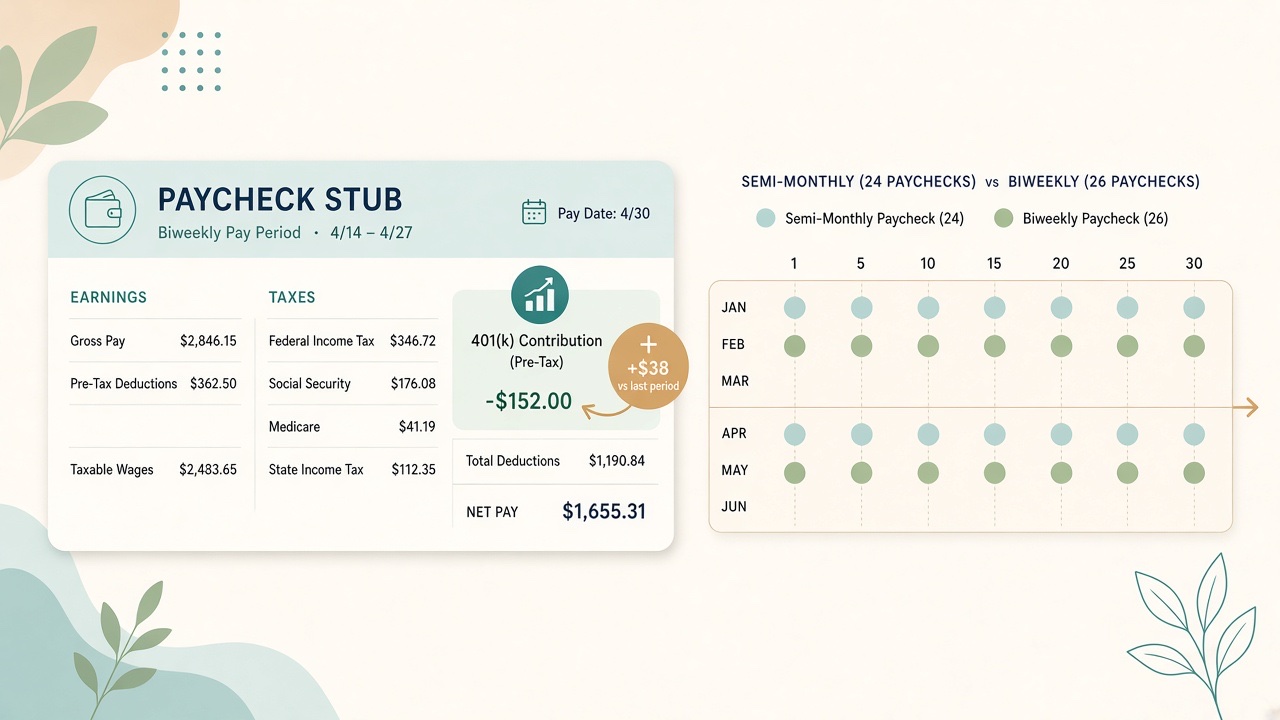
On Nov. 12 the IRS set the 2027 employee contribution limit at $25,500 for 401(k), 403(b), most governmental 457 plans, and the federal Thrift Savings Plan. That is $1,000 above the 2026 cap of $24,500, from IR-2026-136 and Notice 2026-66. If you already filled last year’s max, what changes is how much more leaves each paycheck to get there again.
Split the $1,000 raise across a semi-monthly calendar and you need about $41.67 more per check: $1,062.50 instead of $1,020.83. On a biweekly schedule, the same raise is about $38.46 more per check, or about $980.77 instead of about $942.31. Weekly pay adds about $19.23. Monthly pay adds $83.33. Payroll may round a few cents either way. Confirm the January election against your employer’s real pay dates, or run your schedule in the 401(k) Paycheck Deferral Calculator.
Extra per paycheck if you already maxed $24,500
The IRS raised the employee elective deferral limit by $1,000 for 2027. Divide that raise by your pay schedule. Payroll may round a few cents.
| Pay schedule | Paychecks | 2026 max / check | 2027 max / check | Extra per check |
|---|---|---|---|---|
| Semi-monthly | 24 | $1,020.83 | $1,062.50 | +$41.67 |
| Biweekly | 26 | About $942.31 | About $980.77 | About +$38.46 |
| Weekly | 52 | About $471.15 | About $490.38 | About +$19.23 |
| Monthly | 12 | About $2,041.67 | $2,125.00 | +$83.33 |
Source: IRS IR-2026-136 / Notice 2026-66; Generational paycheck math
Sample match: even deferrals vs front-load
Illustrative $180,000 salary and a common match of 50% of the first 6% of pay on a 24-paycheck calendar. Assumes the match funds only on paychecks where you defer, unless the plan true-ups.
| Path | Your deferrals | Match received | What changes |
|---|---|---|---|
| Even across 24 checks | $1,062.50 × 24 = $25,500 | $225 × 24 = $5,400 | Full annual match if you defer at least 6% each payday |
| Front-load, no true-up | Hit $25,500 by check 16 | $225 × 16 = $3,600 | Miss about $1,800 of match on the last eight checks |
| Same front-load with a true-up | Hit $25,500 by check 16 | $3,600 during the year + about $1,800 true-up | Year-end deposit restores the $5,400 annual match |
Source: Plan design illustration based on a common 50%-of-6% match; confirm your Summary Plan Description
Biweekly is not always 26. Most cycles land on 26 paychecks. A few calendars can show 27 scheduled dates in a year that starts and ends on the same weekday, and a holiday shift can move a New Year’s payday into the prior year. Semi-monthly stays at 24. If you elect a flat dollar amount per check, count the paydates your payroll team will actually run in 2027 before you lock the number.
The employer match is where timing gets expensive. Many plans calculate the match on each paycheck: you defer that day, they match that day. Raise your percentage so you hit $25,500 by summer, then stop, and later checks can show zero deferral and zero payday match. Take a $180,000 salary and a common match of 50% of the first 6% of pay. The full-year match target is $5,400. Spread $1,062.50 of your own money across all 24 semi-monthly checks, keep deferring at least 6% each payday, and you can collect about $225 of match every check. Front-load the IRS max by the 16th check with no true-up, and the last eight checks get nothing. You finish near $3,600 of match and leave about $1,800 on the table.
A true-up can put that money back. After the plan year closes, the administrator applies the match formula to your full-year pay and contributions, then deposits whatever the payday matches still owe. In the sample, that year-end deposit restores the $5,400. Plans are not required to offer one. The Summary Plan Description, the plain-language booklet ERISA requires employers to give participants, must describe how contributions are calculated. Search it for true-up, annual reconciliation, or annualized match. If the wording is fuzzy, ask HR before you race the IRS limit.
Bonus and RSU weeks create the same trap. A big supplemental check with a high percentage election can use the rest of the $25,500 room, then leave later salary checks with no contribution and no payday match. A flat-dollar election sized for 24 or 26 pay dates is easier to track against the ceiling. If you stay on a percentage, recheck the math after a raise or vest. Get the match you already have before you stretch for the last dollar of the cap.
Catch-up changes too. The usual age-50 amount rises to $8,500 in 2027, so most people 50 and older can put in up to $34,000. Ages 60 through 63 get a higher catch-up of $11,750 under SECURE 2.0. The IRA limit stays $7,500, with the age-50 IRA catch-up still $1,100. Catch-up dollars often sit outside the match formula. Confirm that in the same plan booklet.
Plenty of households will not reach $25,500, and that can still be fine once rent and a standing family wire are covered. Society of Actuaries research has found Asian American households among the most likely to work for an employer that offers a retirement plan, so the harder choice is usually how much to put in and whether the match is fully collected. Fidelity’s common educational guideline is about 15% of pretax pay including any employer contribution. Protect the match first, then decide whether the extra $38 or $42 per check fits next to remittances. 401(k) Contribution Rate Benchmarks With Family Support Caps and How to Plan Remittances Without Derailing Retirement keep those lines in one budget. For the earlier biweekly desk note, see The 2027 401(k) Limit Is $25,500. Here’s What Changes on a Biweekly Paycheck..
Before the first 2027 paycheck, write three numbers: the per-check amount from the calculator, the match percent you want on every payday, and whether your plan true-ups if you change the schedule. The IRS set the annual max. Your payroll calendar and plan document decide what hits the stub.
This is educational reporting on IRS contribution limits and common plan design, not tax, investment, or benefits advice. Confirm your plan’s 2027 elections, match formula, and true-up rules with your employer and your own adviser before you change deferrals.
Related content
Further diaspora reading
- 401(k) Contribution Rate Benchmarks With Family Support Caps (Generational)
- How to Plan Remittances Without Derailing Retirement (Generational)
- The 2027 401(k) Max Is $25,500. What Does That Look Like on Your Paycheck? (Generational)
- Lillian Zhang Gives Gen Z a Blueprint for Building Wealth (Goldsea)
- Asian Americans Likely to Benefit from SALT Deduction in Trump Tax Bill (Goldsea)
Generational Take
Get the next Generational Take
Get our latest practical tips and takes in your inbox. No spam.