
The 2027 401(k) Max Is $25,500. What Does That Look Like on Your Paycheck?
The IRS raised the 2027 employee limit to $25,500. That is about $1,062.50 from each semi-monthly check, or about $980.77 if you are paid every other week. Check your match rules before you change how you fill the year.
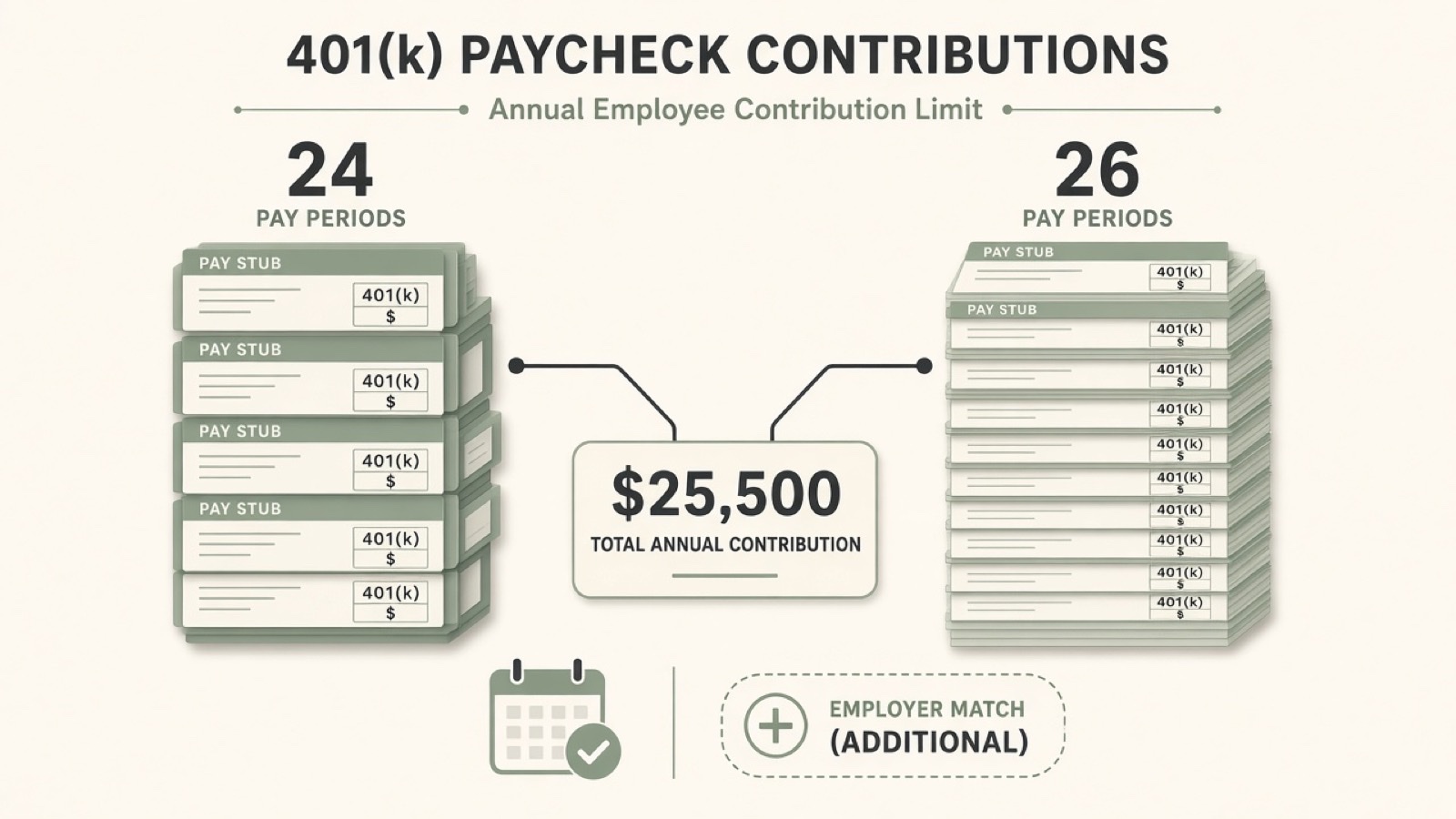
On Nov. 12 the IRS set the 2027 employee contribution limit at $25,500 for 401(k), 403(b), most governmental 457 plans, and the federal Thrift Savings Plan, $1,000 above the 2026 cap. The same notice, IR-2026-136 and Notice 2026-66, raised the usual age-50 catch-up to $8,500 and the ages 60–63 catch-up to $11,750. Those are annual numbers. What shows up on a stub depends on how often you get paid.
Divide $25,500 across 24 semi-monthly checks and you need $1,062.50 each payday. Across 26 biweekly checks, the same max is about $980.77. That is roughly an $82 difference between the two stubs for one annual goal. If you already filled the old $24,500 limit, the new year adds about $41.67 per semi-monthly check or about $38.46 per biweekly check. Payroll may round a few cents either way. Use your employer’s real calendar, not a coworker’s at another company.
Hitting $25,500 on 24 vs 26 paychecks
Divide the 2027 employee contribution limit by your payroll calendar. Your plan may round a few cents. Confirm the January election before the first 2027 check.
| Pay schedule | Paychecks in a year | Per-check amount to hit $25,500 |
|---|---|---|
| Semi-monthly (twice a month) | 24 | $1,062.50 |
| Biweekly (every other week) | 26 | About $980.77 |
| Difference per check | — | About $81.73 more on the semi-monthly stub |
| Same max vs 2026 ($24,500) | 24 / 26 | About +$41.67 / +$38.46 per check |
Sample match: even schedule vs front-load
Illustrative $180,000 salary and a common match of 50% of the first 6% of pay. Assumes the match is funded only on paychecks where you defer, unless the plan true-ups.
| Path | Employee deferrals | Match received | What changes |
|---|---|---|---|
| Even across 24 checks | $1,062.50 × 24 = $25,500 | $225 × 24 = $5,400 | Full annual match if you defer at least 6% each payday |
| Front-load over 16 checks, then stop | Hit $25,500 by check 16 | $225 × 16 = $3,600 | Miss about $1,800 of match with no true-up |
| Same front-load with a true-up | Hit $25,500 by check 16 | $3,600 during the year + about $1,800 true-up | Year-end deposit restores the $5,400 annual match |
The employer match turns that calendar into real money. Say you earn $180,000 and the plan matches 50% of the first 6% of pay. The full-year match target is $5,400. Spread $1,062.50 of your own contributions across all 24 semi-monthly checks, keep putting in at least 6% each payday, and you can collect about $225 of match every check, $5,400 for the year. Now try front-loading: hit the $25,500 IRS limit by the 16th check, then stop. If the plan only matches on paychecks where you contribute, the last eight checks get nothing. You end the year with about $3,600 of match and leave about $1,800 on the table.
A true-up can put that $1,800 back. After the plan year closes, the administrator recalculates the match on your full-year pay and contributions, then deposits whatever the payday matches still owe. In the front-load example, that deposit restores the $5,400 annual match. Skip the true-up, and a mid-year rate change, a raise that bumps your percentage, or an early race to the IRS limit can shrink the match even when your annual total looks strong. Search the Summary Plan Description for true-up, annual reconciliation, or an annualized match. Ask HR if the wording is fuzzy.
Bonus and RSU weeks can create the same problem. A big supplemental check with a percentage election can use up the rest of the $25,500 room, then leave later salary checks with no contribution and no payday match. A flat-dollar election set for 24 or 26 pay dates is easier to track against the IRS ceiling. If you stick with a percentage, check the math again after a raise or vest. Capture the match you already have before you stretch for the last dollar of the $25,500 cap.
Plenty of households will not reach $25,500, and that can still be fine once rent and a standing family wire are covered. 401(k) Contribution Rate Benchmarks With Family Support Caps and How to Plan Remittances Without Derailing Retirement walk through that order. For the biweekly stub alone, see The 2027 401(k) Limit Is $25,500. Here’s What Changes on a Biweekly Paycheck.. For lumpy pay, see RSUs, Bonuses, and Irregular Income for Upwardly Mobile Professionals.
Before the first 2027 paycheck, jot three numbers: $1,062.50 or about $980.77, depending on your calendar; the match percent you want on every payday; and whether your plan true-ups if you change the schedule. The IRS set the annual max. Your payroll calendar and plan document decide what hits the stub.
Related content
Further diaspora reading
- The 2027 401(k) Limit Is $25,500. Here’s What Changes on a Biweekly Paycheck. (Generational)
- 401(k) Contribution Rate Benchmarks With Family Support Caps (Generational)
- How to Plan Remittances Without Derailing Retirement (Generational)
- Asian Americans Likely to Benefit from SALT Deduction in Trump Tax Bill (Goldsea)
- IRS set the 2027 joint standard deduction at $33,200. Model dual-income cash flow now. (Generational)
Generational Take
Get the next Generational Take
Get our latest practical tips and takes in your inbox. No spam.