
Treat the August Visa Bulletin as a financial-planning document
The dates matter. What they change for diaspora households is the plan around them: home purchases, equity exercises, job moves, parent support, emergency cash, and how portable your assets stay while the queue does not.
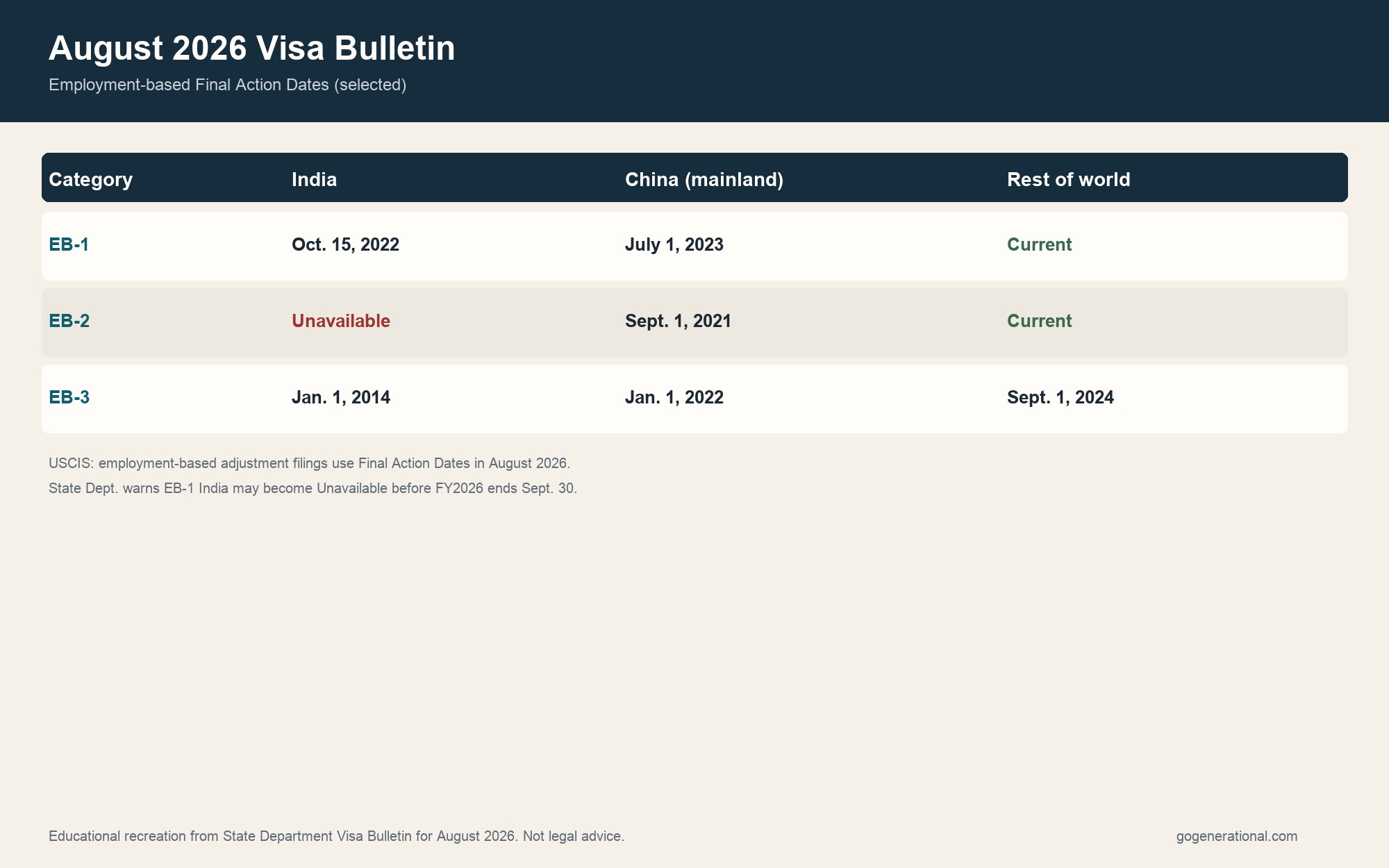
Most people open the Visa Bulletin to see whether their priority date moved. It is worth reading a second way, the way a finance team reads a rate sheet: as the constraint that prices everything else on the page. August 2026 moved almost nothing, which makes it a useful month to work through.
The bulletin is the State Department’s monthly table of immigrant visa availability. Final Action Dates control when a green card can be approved or an immigrant visa issued. Dates for Filing tell some applicants when they may submit paperwork earlier. “C” means current. A calendar date means only earlier priority dates can take a number. “U” means Unavailable: no numbers in that category until a new fiscal year, usually October 1. U.S. Citizenship and Immigration Services said that for August, employment-based adjustment filers must use the Final Action chart.
On that chart, India EB-1 remains October 15, 2022, China EB-1 advances to July 1, 2023, and most of the world stays current in EB-1 and EB-2. India EB-2 is Unavailable. India EB-3 is still January 1, 2014. China EB-2 holds at September 1, 2021, and China EB-3 edges to January 1, 2022. Worldwide EB-3 advances to September 1, 2024. State also warns that EB-1 India may become Unavailable before the fiscal year ends on September 30 if demand burns the remaining allotment. For the date-by-date news read, see August Visa Bulletin freezes EB-1 India at Oct. 15, 2022. This piece is about what those lines do to money.
Housing is where the queue bites hardest, because a mortgage is the one signature that assumes years of steady income. Fannie Mae, the government-sponsored buyer whose standards most U.S. lenders follow, purchases loans made to lawful non-permanent residents on the same credit terms as citizens when the borrower is legally present and the income verifies. Individual lenders pile on their own overlays: remaining visa validity, I-797 approval history, sometimes an approved I-140 for comfort. So a category stuck in 2014 rarely blocks the purchase itself. The pressure shows up in the stress test, and the honest version of that test asks whether the payment survives a layoff, a 60-day H-1B grace period, or a spouse losing work authorization. Run the remittance line through the First Home Affordability Calculator before a school-year move-in date starts standing in for a green-card date.
That payment assumes the paycheck, which is why a job change carries more weight here than the salary difference suggests. American Competitiveness in the Twenty-first Century Act rules, known as AC21, can let some employment-based applicants move to a new job once Form I-485 has been pending 180 days, if the new role is in the same or a similar occupation and Supplement J is filed. H-1B workers can usually start with a new employer as soon as a transfer petition is properly filed, and many can extend past the six-year cap when an I-140 is approved and no Final Action Date is available. None of it is automatic. A jump that breaks the petition path, or a gap taken without a filed transfer, can cost a household more than the raise pays. Price the move with Visa and Job Change Runway When Leave Means Status Risk and Visa, Job Change, and Benefits Gap Basics for Diaspora Professionals.
The cushion most people assume will cover that kind of gap is equity, and equity is the least dependable piece of the plan. Restricted stock units vest on a company calendar that ignores the bulletin completely. Selling a vest to fund a down payment, a parent’s hospital bill, or a return ticket produces cash at a moment you did not choose, and it gets harder to hold onto if you later leave the country, since many U.S. brokerages restrict trading or close accounts once a foreign address lands on the file. A vest that straddles U.S. and India workdays can also leave withholding gaps in both tax systems. Treat a large vest week as a status event as much as a payday. RSU Vest Day Playbook for Diaspora Households maps the mechanics.
That pushes the work back onto cash. Standard three-month advice assumes you can take any job next month, and employer-linked work authorization is the opposite of that. Six months of essentials is a fairer floor, and the essentials list should include immigration counsel fees, COBRA premiums, and the family support you would not cut during a short crisis. Keep it somewhere FDIC-insured you can reach without selling stock into a bad week. Emergency Fund Benchmarks When Family Depends on You and today’s family liquidity ratio are two ways to keep that runway honest.
Family support competes for the same account, and the bulletin does nothing to slow it down. A category marked Unavailable has no effect on a hospital bill in Hyderabad or a rent gap in Guangzhou. It can, though, delay the flexibility you would use to absorb one: a clean employer change, travel without a re-entry worry, spouse work authorization on a schedule you can plan around. Cap the monthly send at a level a status gap would not blow through, hold a separate buffer for flights and medical spikes, and have the pause conversation early. The Family Support Budget Calculator keeps those lines visible next to rent and retirement.
Then there is the version where none of it works out and you leave. Before that becomes a live option, inventory which brokerage, bank, and retirement accounts survive a foreign address. Some firms freeze mutual-fund purchases; others mail a closure letter. Further out, Internal Revenue Code Section 877A can treat certain people who give up long-term green card status as covered expatriates subject to a mark-to-market exit tax, once the eight-of-fifteen-year residency test and the income or net-worth thresholds are met. That sits years downstream from an August bulletin read, and it is why “we can always go back” deserves a professional’s look before it becomes the plan.
The August version of all this fits on one note. Write down your preference category, chargeability country, and priority date. Confirm which chart USCIS is using this month for employment filings. Mark whether your date sits ahead of the cutoff, behind it, or in a category with no numbers at all. Then list the money decisions that quietly assume a green card by a certain year, and rewrite each one so it still works if nothing moves before the fiscal year closes on September 30.
All of this is household planning context rather than immigration, tax, or mortgage advice. Priority dates, petition history, and lender overlays turn on individual facts, so bring in an immigration attorney and a cross-border tax professional before you file, resign, exercise, or expatriate. The bulletin will keep arriving in the middle of every month either way. The households that come out ahead are the ones who read it with a budget open.
Related content
Further diaspora reading
- August Visa Bulletin freezes EB-1 India at Oct. 15, 2022. State warns the category may go unavailable within weeks. (Generational)
- Your cash looks ample until you run the family liquidity ratio (Generational)
- Visa and Job Change Runway When Leave Means Status Risk (Generational)
- RSU Vest Day Playbook for Diaspora Households (Generational)
- Highs and Lows of Asian Multi-Generational Living (Goldsea)
Generational Take
Get the next Generational Take
Get our latest practical tips and takes in your inbox. No spam.