
4.5% of household debt is late. Student loans newly hitting 90 days are at 14%.
The New York Fed’s Q3 household number barely budged. Break it open by loan type and age, and student loans still lead the share of balances newly entering serious delinquency, especially among borrowers 50 and older.
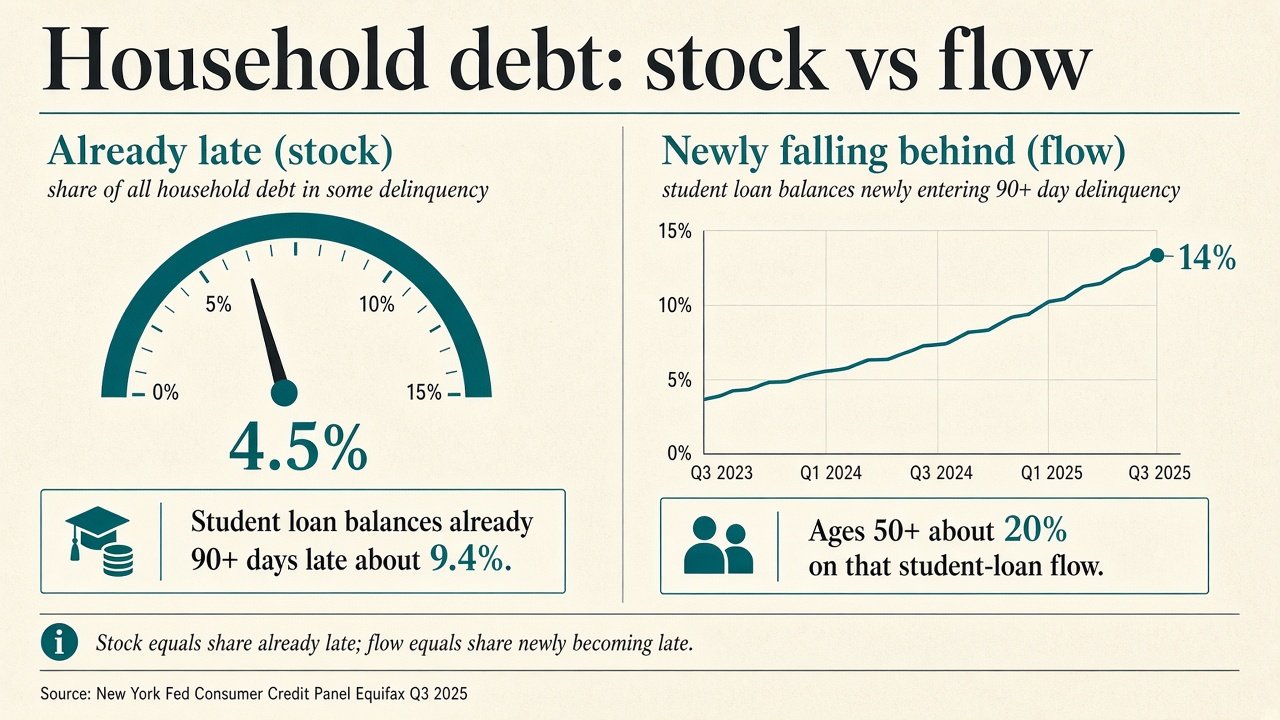
The New York Fed’s third-quarter household debt release, out November 5, 2025, looks almost steady at first glance. About 4.5% of outstanding U.S. household debt was in some stage of delinquency, only a tenth of a point higher than the prior quarter. Donghoon Lee, an economic research adviser at the New York Fed, said delinquency rates were stabilizing even as balances rose. The student-loan lines and the age charts tell a less tidy story.
Two measures matter, and they are easy to mix up. Stock delinquency is the share of balances already late at the end of the quarter. Flow, or transition into delinquency, is the share of balances that were current or less than 90 days late and then newly crossed into serious delinquency. Serious delinquency means 90 or more days past due. Early delinquency means 30 or more. The overall stock can sit nearly flat while new late balances keep arriving, especially when one loan type is doing most of the moving.
Stock vs flow: what Q3 2025 actually prints
Stock is the share of balances already late at quarter end. Flow is the share of balances that newly became 90 or more days late. Flow rates match the New York Fed press table of annualized shares transitioning into serious delinquency.
| Measure | Figure | What it answers |
|---|---|---|
| All household debt in some stage of delinquency | 4.5% | How late is overall household debt right now? |
| Student loan balances already 90+ days late | 9.4% | How much student debt is already deep late? |
| Student loan flow into 90+ days late | 14.26% | How much was newly becoming seriously late? |
| Same student loan flow a year earlier | 0.77% | How the reporting pause changed the year-ago number |
| Student loan flow into 90+, ages 50+ | 19.92% | Which age group leads on student-loan transitions? |
| All-debt flow into 90+, ages 18–29 | 4.95% | Young adults lead when every loan type is mixed |
Flow into serious delinquency by loan type
Annualized share of balances newly becoming 90 or more days late. Student loans lead every other product on this cut.
| Loan type | Q3 2024 | Q3 2025 |
|---|---|---|
| Student loan | 0.77% | 14.26% |
| Credit card | 7.10% | 7.05% |
| Other | 5.50% | 5.35% |
| Auto | 2.90% | 2.99% |
| Mortgage | 1.08% | 1.28% |
| HELOC | 0.43% | 1.27% |
| All debt | 1.68% | 3.03% |
In Q3, that loan type is student debt. Outstanding student balances stood at $1.65 trillion. The stock reported as 90 or more days delinquent or in default was 9.4%, down from 10.2% in the second quarter and up from 7.8% in the first. That is the already-late figure. The flow into serious delinquency for student loans was 14.26%, up from 0.77% a year earlier, when most missed federal payments still stayed off credit files. The release says missed federal payments that were not reported between 2020Q2 and 2024Q4 are now appearing. The elevated student rates sit on that restart.
Line the products up and the contrast sharpens. On the press table’s annualized flow into serious delinquency, student loans at 14.26% sit well above credit cards at 7.05%, auto loans at 2.99%, and mortgages at 1.28%. All debt combined rose to 3.03% from 1.68% a year earlier, largely because student loans pulled the average. On the stock cut, cards look worse: about 12.4% of credit-card balances were already 90 or more days late, versus about 9.4% of student-loan balances. Cards lead on who is already deep late. Student loans lead on who is newly crossing that line.
Age depends on which table you open. For student loans alone, the New York Fed’s four-quarter moving sum of transitions into serious delinquency rises with age: 9.22% for ages 18 to 29, 12.82% for 30 to 39, 14.77% for 40 to 49, and 19.92% for ages 50 and older. Older borrowers lead that cut. For all debt types mixed together, the same kind of transition chart peaks at ages 18 to 29 at 4.95% and declines with age. Young adults lead when mortgages, cards, autos, and student loans are blended. Keep those two rankings separate.
The older student-loan pattern fits what New York Fed researchers wrote earlier in 2025 on Liberty Street Economics after reporting resumed. Among borrowers with a payment due, people under 30 had the lowest delinquency rates, and the average delinquent borrower had moved into the low 40s. Parent PLUS loans, which parents take for a child’s education, help explain why a late student-loan balance can sit on a 50-something credit file. The Q3 report does not break Parent PLUS out as its own line. It does support the age ranking on student-loan transitions.
The quarterly PDF also skips race and ethnicity, so it cannot give you an Asian American or first-gen delinquency rate. For a household carrying tuition debt next to rent and family wires, the practical read is narrower. Treat 4.5% as the whole-household weather. Then ask whether your file is student-loan heavy, whether the late mark is already on the report or newly arriving, and whether the borrower is a recent graduate or a parent who signed. Student Debt and Net Worth Milestones for First-Gen Professionals and Debt Payoff Priority Benchmarks With Family Support Obligations help order the bills. Credit and Family Money Myths for Immigrant Households covers how a score hit shows up on the next lease or car note.
When the next New York Fed household credit report lands, ask two questions beside the headline. What share of balances is already late? What share newly became 90 days late, by loan type and age? The first number can look flat. The second is where student loans, and older borrowers on that product, still show up.
This is educational reporting on Federal Reserve research, not credit, tax, or legal advice. Confirm your own loan status, servicer options, and credit reports before you change repayment plans.
Related content
Further diaspora reading
- Student Debt and Net Worth Milestones for First-Gen Professionals (Generational)
- Debt Payoff Priority Benchmarks With Family Support Obligations (Generational)
- Credit and Family Money Myths for Immigrant Households (Generational)
- Comparing the Cost of College in the US and China (Goldsea)
- The High-Income Trap: Why Upwardly Mobile Asian Professionals Still Feel Broke (Generational)
Generational Take
Get the next Generational Take
Get our latest practical tips and takes in your inbox. No spam.