
Two-thirds of mass-affluent inheritors are planning around money they never confirmed.
Key Wealth’s 2026 Inheritance Pulse Poll finds 64% of mass-affluent Americans who expect an inheritance are already reshaping savings and risk around it, while only 34% ever confirmed figures, timing, or conditions with family. For diaspora households, that silence often sits beside care costs that can spend the estate down.
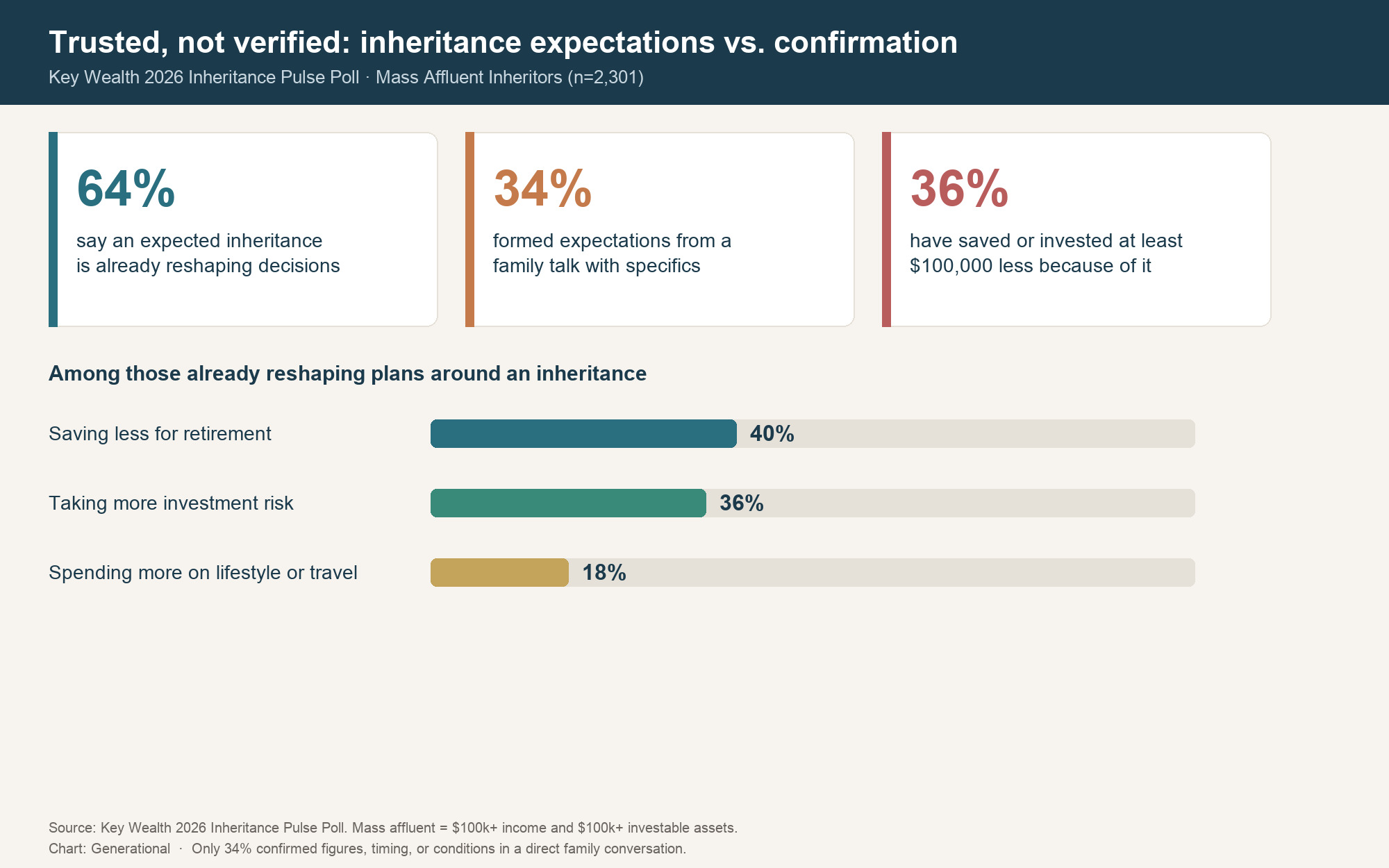
Nearly two-thirds of mass-affluent Americans who expect an inheritance say that windfall is already reshaping how they save, invest, and spend. That finding comes from Key Wealth’s 2026 Inheritance Pulse Poll, released July 15, 2026. Key Wealth is the wealth-management business of KeyCorp, the Cleveland bank that operates as KeyBank. The catch is sitting in the next number: only 34 percent formed those expectations through a direct family conversation that covered specific figures, timing, or conditions.
The rest are building plans on trust, not verification. More than a third (36 percent) say they have already saved or invested at least $100,000 less because they are counting on money that may never arrive in the size or on the schedule they imagine. For diaspora kitchens, that gap is familiar. Many adult children can feel greedy just asking. Parents can feel that naming a will invites bad luck. Silence fills in the blanks with a down payment fantasy or an earlier retirement date.
Key Wealth screened 3,809 U.S. adults who reported at least $100,000 in household income and at least $100,000 in investable assets, its definition of mass affluent for this poll. The full behavioral findings come from 2,301 respondents who said they expect or have already received an inheritance, a group the firm calls Mass Affluent Inheritors. Fieldwork ran online from mid-April through mid-May 2026. These are not all American households. They are higher-income households that already believe an inheritance is in the picture.
Solomon Schmidt, a CFP who serves as executive vice president and head of mass affluent wealth at Key Wealth, put the household rule in one line: treat inheritances like bonuses. They are never guaranteed. The strongest plan, he said, can stand on its own with or without the windfall. When people believe a safety net is coming, he added, it changes the calculus behind saving, investing, and planning overall.
Among inheritors whose decisions have already been shaped by that belief, 40 percent say they are saving less for retirement, 36 percent are taking more investment risk, and 18 percent are spending more freely on lifestyle or travel. Forty-four percent report pulling back on savings or investments by at least $25,000 over the past five years. The $100,000-plus shortfall shows up for more than one in three people in the qualified sample.
Confidence and exposure can live in the same household. Six in ten Mass Affluent Inheritors rate their financial plan as “very prepared” regardless of any expected inheritance. A quarter say they would need to work significantly longer than planned if the inheritance fell through. Nearly one in five would face a reduced retirement lifestyle. Healthcare and long-term care costs top the list of threats that could put plans at risk, cited by 40 percent, ahead of a family member outliving their assets, changes in estate or gifting plans, and market volatility.
That threat ranking matters in Asian American and other diaspora families that prefer aging at home and already spend on care, remittances, and sibling coordination. Long-term care shows up as an invoice that can quietly spend down the house, brokerage account, or foreign property adult children were treating as a future floor. Asking “what happens if care lasts ten years?” is often a clearer first question than “how much do I get?”
Among those who have never raised inheritance with family, half say they stay quiet because they do not want to look like they are counting on the money. Filial norms make that fear sharper. In many households, bringing up a will can sound like wishing someone gone or auditioning for a payout. The Key Wealth data points toward planning as if the check never clears, then using a calmer conversation later to confirm documents, beneficiaries, and care funding.
Women show a different mix of exposure and caution. Separate research cited in the release says U.S. women are on track to nearly double their assets by 2030, yet in this poll only 41 percent of women have discussed their inheritance with a financial advisor, compared with 54 percent of men. Just 17 percent say inheritance is a significant part of their long-term financial plan. More than half of women say inheritance expectations have not changed their saving behavior at all. Among people already reshaping decisions, women were less likely than men to pile on investment risk or cut retirement contributions.
The cycle is already set to repeat. Seven in ten respondents intend to leave a legacy for their children, but 38 percent have no formal estate plan. Without one, heirs can inherit assets and the same fog: assumptions, silence, and unverified expectations. Demand for help is high. Seventy-eight percent of Mass Affluent Inheritors say an advisor-facilitated family conversation on inheritance would be valuable. Fewer than half have ever had one.
Great Wealth Transfer headlines, including widely cited Cerulli Associates figures near $124 trillion in U.S. transfers through 2048, can make an inheritance feel like a demographic certainty. Key Wealth’s poll is a reminder that a national transfer total is not a household wire confirmation. Money can go to a spouse first, to care costs, to charity, to a rewritten will, or to overseas property that never clears U.S. probate the way a sibling expects.
Practical moves stay modest and specific. Build your retirement and housing plan so it works if the inheritance is zero. Keep remittances and parent-care support in named budget lines so they do not silently replace your 401(k) raise. Ask whether a will, trust, beneficiary forms, and powers of attorney exist, not what dollar amount you are “owed.” If parents are comfortable but silent, start with documents and care funding before percentages. If siblings already disagree about fairness, name caregiving and prior gifts before anyone drafts equal shares.
Use Inheritance and Estate Conversations in Diaspora Families for a first 45-minute map of people, assets, and paperwork. Cross-Border Inheritance and Probate Awareness for Diaspora Families covers foreign property and probate friction. Navigating Family Wealth as the Professional Adult Child and When Your Immigrant Parents Are Already Financially Comfortable help when the money is real and the conversation still feels off-limits. Keep monthly support visible in the Family Support Budget Calculator and care scenarios in the Parent Care Cost Planner.
Treat the poll as educational context for household planning, not a prediction about your parents’ estate. State law, beneficiary designations, and foreign titles control outcomes more than dinner-table assumptions. When the numbers are large or siblings are already tense, bring in an estate attorney or fee-only planner who can read the actual documents.
An inheritance can still arrive and still help. The Key Wealth finding is narrower and harder: millions of higher-income households are already spending the gift in their heads. The safest plan is the one that still works if the gift never leaves the account.
Related content
Further diaspora reading
- Nearly half of older Asian homeowners expect to leave an inheritance. About 1 in 10 Asian households report receiving one. (Generational)
- Equal Isn’t Always Fair: How Asian American Families Divide an Inheritance (Generational)
- Inheritance and Estate Conversations in Diaspora Families (Generational)
- Cross-Border Inheritance and Probate Awareness for Diaspora Families (Generational)
- Highs and Lows of Asian Multi-Generational Living (Goldsea)
Generational Take
Get the next Generational Take
Get our latest practical tips and takes in your inbox. No spam.