
Open a Canadian FHSA in December. Your 2027 room can jump to $16,000.
Two eligible buyers set aside the same $16,000 for 2027. Open the First Home Savings Account in December and the whole amount can go in next year. Wait until January and only $8,000 fits.
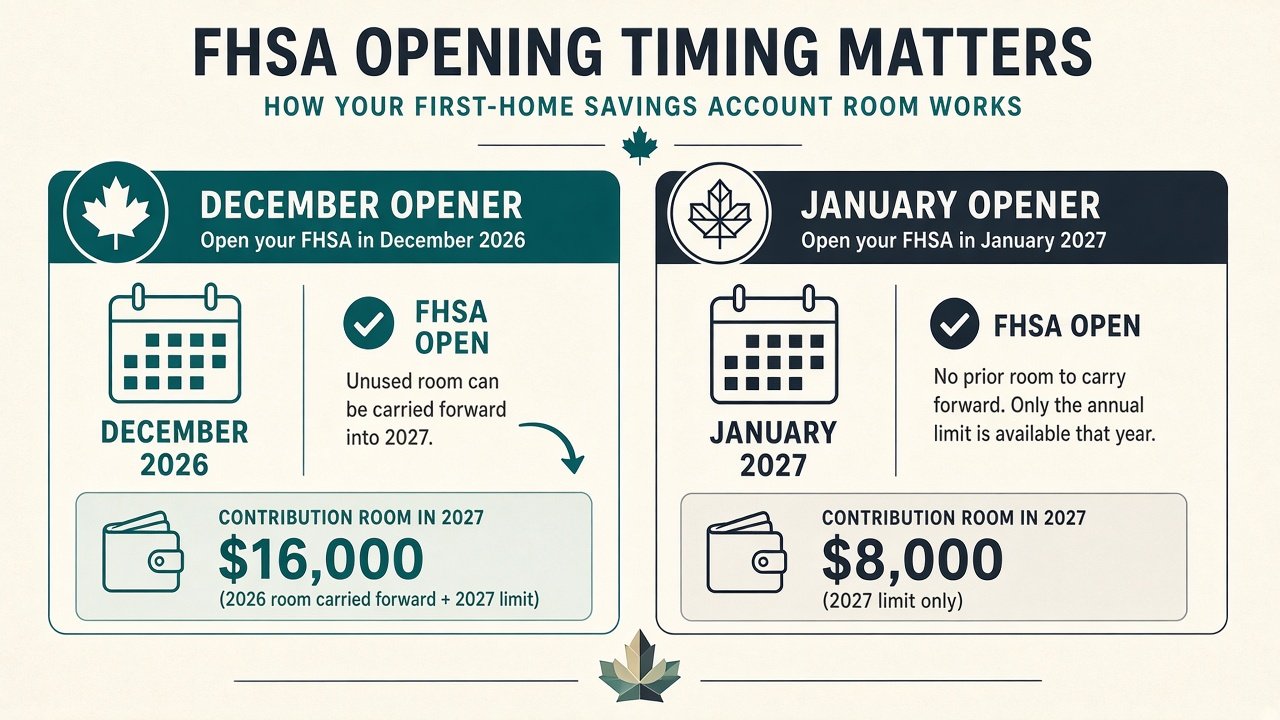
If you are eligible for a Canadian First Home Savings Account and still waiting to open one, December can change how much room you have in 2027. The Canada Revenue Agency’s own example is simple: someone who opened an FHSA in 2026, put nothing in, and filed Schedule 15 still saw $16,000 of participation room for 2027. Wait until January to open, and that year starts at $8,000.
Participation room is the most you can contribute, or transfer from an RRSP, into your FHSAs in a calendar year without creating an excess amount. In the year you open your first FHSA, that room is $8,000. The month does not matter. Open in June or December and you still get the full $8,000 for that year. Unused room can carry into the next year, up to another $8,000, so a quiet year often becomes a $16,000 year. The lifetime participation limit is $40,000. A Tax-Free Savings Account builds room whether or not you open one. An FHSA does not. Until the first account exists, your room is zero.
Same $16,000 of 2027 savings, two opening dates
Both buyers are eligible Canadian residents and first-time home buyers. Neither contributes in the month the account opens. Each has $16,000 ready for down-payment savings during 2027.
| Step | Maya opens Dec. 2026 | Jordan opens Jan. 2027 |
|---|---|---|
| 2026 participation room | $8,000 | $0 (no FHSA yet) |
| 2026 contribution | $0 | n/a |
| 2027 participation room | $16,000 | $8,000 |
| How much of the $16,000 can enter the FHSA in 2027 | $16,000 | $8,000 |
| Largest FHSA deduction available for 2027 deposits (if claimed) | Up to $16,000 | Up to $8,000 |
| When the 15-year account clock starts | December 2026 | January 2027 |
Line up two eligible buyers with the same cash plan. Maya and Jordan are both Canadian residents and first-time home buyers under the CRA opening test. Each will have $16,000 ready for down-payment savings during 2027. Maya opens an FHSA in December 2026 and contributes nothing that month. Jordan waits and opens in January 2027. Maya’s unused 2026 room carries forward, so her 2027 participation room is $16,000 and the full pile can go into the FHSA. Jordan’s first year is 2027, so his room that year is $8,000. Half of the shared plan fits inside the account. The other $8,000 sits outside until later years of room show up.
The tax deduction follows the calendar year of the contribution. Forget the RRSP habit of counting the first 60 days of the new year against last year’s return. Money that lands in the FHSA between January 1 and December 31 can be claimed on that year’s return, or held and deducted later if you prefer. A deposit in January 2027 does not help a 2026 return. Transfers from an RRSP into an FHSA use participation room but are not deductible. Over a lifetime you can deduct at most $40,000 of FHSA contributions, and RRSP transfers eat into that headroom even though they never show up as a deduction.
Opening also starts the account clock. Your maximum participation period begins when you open your first FHSA. It ends on December 31 of the year when the earliest of three things happens: the 15th anniversary of that opening, the year you turn 71, or the year after your first qualifying withdrawal. Maya’s clock starts in December 2026. Jordan’s starts in January 2027. For most first buyers, one earlier year on that 15-year window is a fair trade for the extra room. Just make sure the issuer actually registers the account in 2026. An application that settles in January does not create 2026 room.
You still have filing work with a zero balance. In the year you open your first FHSA, fill out Schedule 15 on your income tax and benefit return so the CRA knows the account exists. After assessment, check your participation room statement before you send a large deposit. Your issuer later sends a T4FHSA for contribution years. Put in more than your room and the CRA generally applies a 1% monthly tax on the excess until it is cleared.
Eligibility is a checklist, not a feeling. You need to be a resident of Canada, at least 18 (or the age of majority where that is 19), and 71 or younger as of December 31 of the opening year. You also need to clear the first-time home buyer test for opening: in the current year before you open, and in the prior four calendar years, you did not live in a qualifying home that you owned or that your spouse or common-law partner owned. Qualifying withdrawals for a first home have their own first-time buyer test. If parents are wiring closing funds later, keep that path separate from the FHSA calendar with Parent Down-Payment Gift Playbook That Closes Clean. Size the house against rent and family wires with Housing Cost Burden Benchmarks for Diaspora Households and the First Home Affordability Calculator.
If you already planned to open an FHSA in early 2027, ask the bank what cutoff gets the account live in 2026. Same savings, different December: one buyer walks into 2027 with $16,000 of room, and the other walks in with $8,000.
This is educational reporting on Canada Revenue Agency rules, not tax, legal, or mortgage advice. Confirm eligibility, issuer cutoffs, and your own Schedule 15 with a qualified professional before you open or fund an account.
Related content
Further diaspora reading
- Parent Down-Payment Gift Playbook That Closes Clean (Generational)
- Canada Published Its 2027 RRSP and CPP Numbers. They Show Up in Different Places. (Generational)
- U.S.–Canada Dual-Life Family Money Basics (Generational)
- Is the Asian Canadian Dream Surpassing the Asian American Dream? (Goldsea)
- Missed a Year of Canadian Education Grants? What a December RESP Contribution Can Recover. (Generational)
Generational Take
Get the next Generational Take
Get our latest practical tips and takes in your inbox. No spam.