
Nasdaq falls 5.5% into a correction. Index funds, QQQ, and RSUs already stacked the same AI names.
The Magnificent Seven lost more than $1 trillion in a day. A sample portfolio shows how a target-date fund, a Nasdaq tracker, employer stock, and a single growth name can still be the same bet three times over.
The Nasdaq Composite fell 5.5% on Thursday, November 5, closing more than 10% below its early-October record and into what traders call a correction. The S&P 500 dropped about 4.4%. The Dow Jones Industrial Average lost roughly 1,833 points, or 3.4%. CNBC reported it as the steepest one-day slide for those averages since the April 2025 tariff shock.
Artificial-intelligence-linked technology led the decline. The "Magnificent Seven" — Apple, Microsoft, Nvidia, Alphabet, Amazon, Meta, and Tesla — lost more than $1 trillion in combined market value, with Nvidia alone shedding more than $440 billion, according to CNBC. Nvidia fell more than 9%. Chip names such as Micron and Advanced Micro Devices dropped about 17%. The Technology Select Sector SPDR Fund, often abbreviated XLK, fell about 8%.
Wires tied the selling to fresh midterm results, mixed chip forecasts, and fear that data-center buildouts could face tighter scrutiny. Policy will keep moving. For diaspora households, the durable file is portfolio plumbing: many accounts that look diversified already owned the same AI names more than once.
Market-cap-weighted indexes give the largest companies the largest weights. In October, Motley Fool put the Magnificent Seven near 35% of S&P 500 market value. Early-November readings still sit around a third. Roughly one dollar in three in a plain S&P 500 fund is already those seven tickers.
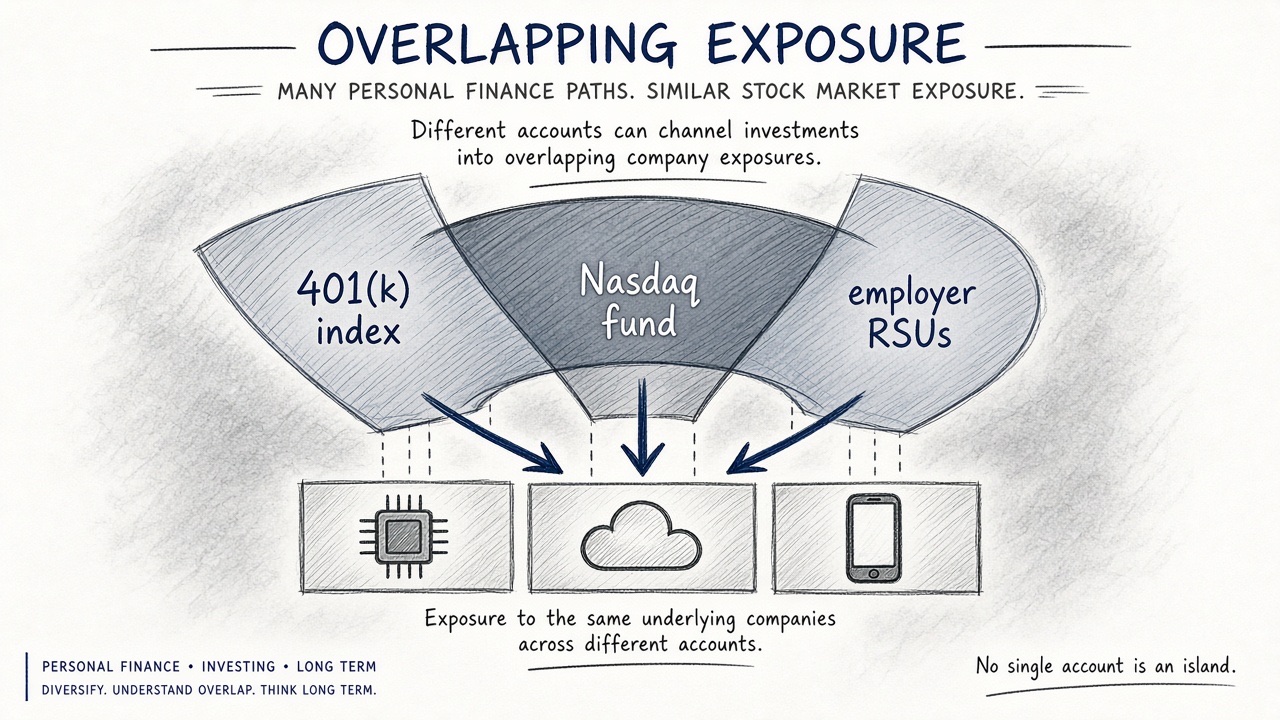
Look under a common brokerage sleeve and the stack gets taller. Invesco's QQQ, which tracks the Nasdaq-100, listed Apple at about 8.3%, Nvidia at about 7.8%, and Microsoft at about 6.7% of assets as of November 4. Vanguard's S&P 500 ETF, VOO, showed Nvidia near 8.4%, Apple near 7.4%, and Microsoft near 5.8% in early-November holdings files. Owning both an S&P 500 core and a Nasdaq fund is not two independent bets. It is often the same mega-caps with different wrappers.
Retirement defaults amplify that pattern. Vanguard's How America Saves 2026 report says 98% of plans that name a qualified default investment alternative choose a target-date fund, and 84% of participants use target-date funds when the plan offers them. Fortune noted in September that more than 80% of 401(k)s default into target-date index products that inherit market-cap weights. A set-it-and-forget-it sleeve is still a concentrated U.S. growth sleeve when the market itself is concentrated.
Target-date funds do not escape the same names. A mid-2026 look-through of SEC Form N-PORT filings, compiled by Ticker Inside, put Nvidia at about 3.4%, Apple at about 3.2%, and Microsoft at about 2.1% of Vanguard Target Retirement 2050 Fund. Those are single-stock slices inside a product many households treat as already diversified across hundreds of holdings.
Now add the pieces many first-gen tech households actually hold. Asian workers were 18.1% of the U.S. high-tech workforce in the Equal Employment Opportunity Commission's 2014–2022 high-tech study, versus 6.5% of the overall workforce. Restricted stock units — company shares that unlock on a vest schedule — show up more often in those seats. FINRA, the U.S. broker-dealer regulator, warns that employer stock can leave salary and portfolio tied to the same ticker, and notes that some experts keep any single stock near or below about 10% of investment assets. FINRA does not prescribe one percentage for every household.
Here is an illustrative look-through, not a recommendation. Imagine half the portfolio in a 2050-style target-date fund, 20% in QQQ, 15% in Microsoft employer stock, and 15% in individual Nvidia shares. Using the mid-2026 target-date look-through and the November 4 QQQ weights, Nvidia alone lands near 18% of the whole portfolio. Microsoft lands near 17%. Apple still shows up around 3% from the funds alone. Three companies approach about 39% of a mix that looks diversified on a statement screen.
Morningstar's Stock Intersection and similar X-Ray tools exist for this exact blind spot: they look through funds and add the same company across sleeves. Brokerage apps that only show "U.S. equity" versus "international" will not. Pull the top holdings of each fund you own, multiply by the sleeve's share of the portfolio, then add any individual shares and vested employer stock. Unvested grants that will unlock this year belong on the same sheet if you want an honest job-plus-portfolio total.
None of that math predicts whether AI spending accelerates or stalls. Equal-weight S&P 500 products such as Invesco's RSP shrink mega-cap dominance by resetting each company near 0.2% at rebalance, but they can lag when the largest names lead. International sleeves change the country mix; they do not erase Nvidia if your U.S. core and your Nasdaq fund still own it heavily.
For a household sending money home, funding a parent visit, or timing an RSU vest, the useful next step after a day like Thursday is a map. RSU Vest Day Playbook for Diaspora Households walks through vest-day sales and concentration caps. Taxable Investing Basics for First-Gen Professionals is for the brokerage sleeve that sits beside the 401(k). Keep the family support line visible on the Household Dashboard so a tech drawdown does not silently raid the remittance budget.
Thursday made the overlap hard to ignore. It was already sitting on the statement.
Related content
Further diaspora reading
- RSU Vest Day Playbook for Diaspora Households (Generational)
- Asian workers get employer stock more often. Inside those jobs, the grants look about the same. (Generational)
- Cognition AI Raises $2 Billion at $48 Billion Valuation (Goldsea)
- 2 Jains Trigger Big-Tech Shootout at AI Corral (Goldsea)
- Palona AI Delivers Online Agents with Big Selling Personalities (Goldsea)
Generational Take
Get the next Generational Take
Get our latest practical tips and takes in your inbox. No spam.