
Arista grows 58.5% as AI clusters need more switches. The networking bill is catching up to the GPUs.
Q3 revenue hit $3.66 billion and full-year guidance rose to about $13.3 billion. Switch sales, inventory, and silicon purchase commitments show hyperscalers are still wiring the fabric between accelerators.
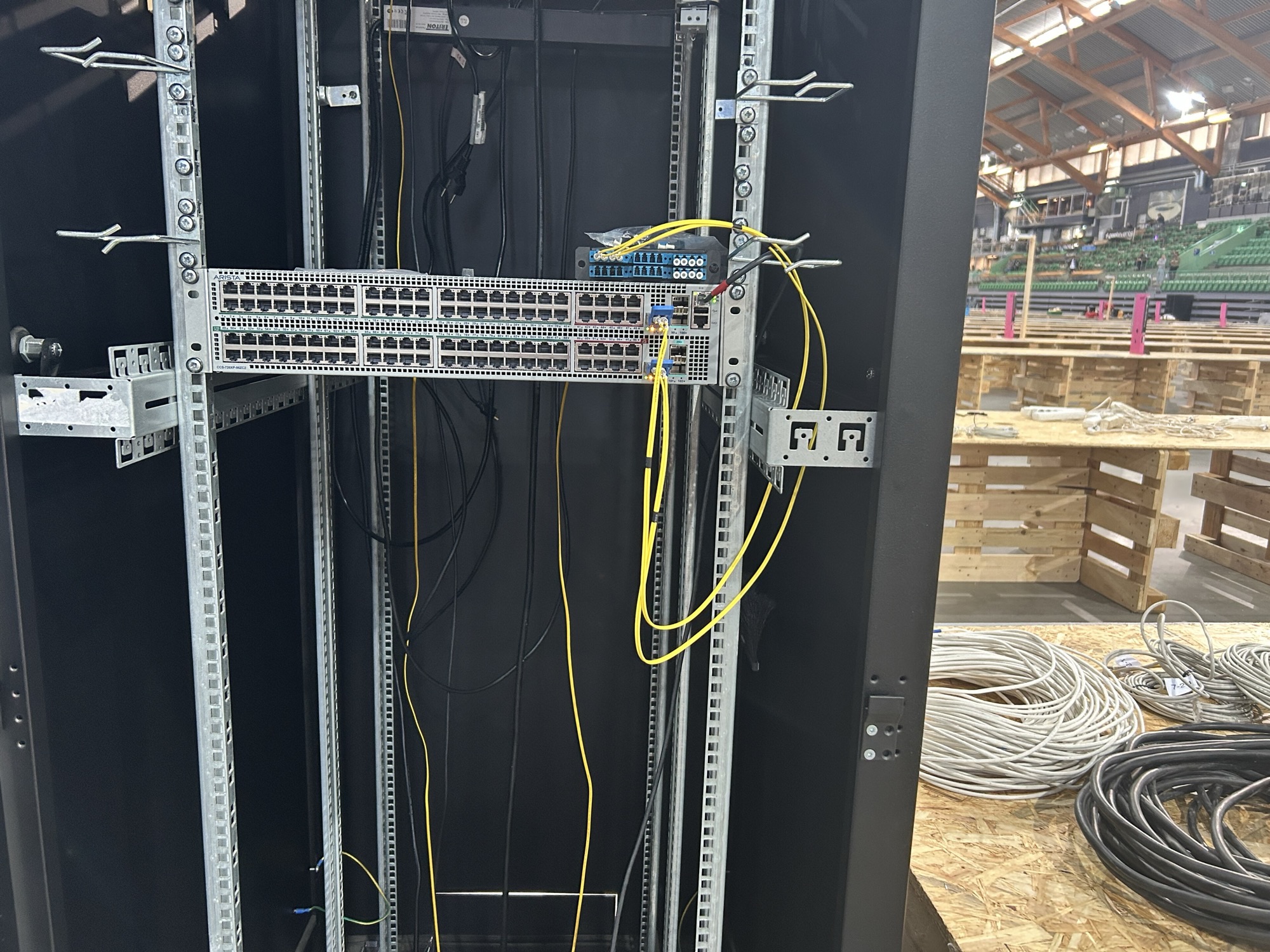
Arista Networks reported third-quarter revenue of $3.66 billion on November 3, up 58.5% from a year earlier, the company's fastest year-over-year growth since its IPO. The figure topped the company's own guidance of about $3.3 billion.
Non-GAAP earnings came in at $1.20 a share, ahead of Wall Street's roughly $1.08 estimate. Jayshree Ullal, Arista's chairperson and chief executive, said AI networking demand exceeded even her high expectations. Chantelle Breithaupt, the chief financial officer, said the quarter set records in revenue growth, net income, and earnings per share.
The household read sits one layer below the GPU poster. Training and running large models needs accelerators. It also needs a fabric that moves data between those machines without dropping packets. When switch sales jump, that is often a receipt for the second bill.
Arista sells Ethernet switches and the software that runs them, Extensible Operating System, or EOS. For AI clusters, the company groups that work under Etherlink: a portfolio of at least 25 switches built for three jobs. Scale-out connects accelerators across racks inside a data center. Scale-across links clusters between buildings or sites. Scale-up tightens the links inside a rack, where latency is measured in tiny fractions of a second. Ullal has said scale-up is unlikely to move much revenue next year, so the near-term AI story is scale-out and scale-across.
Those distinctions matter for reading the buildout. Chipmakers get the loudest CapEx headlines. Networking suppliers collect when operators actually wire the pods together. Arista now counts more than 100 Etherlink customers, up from about four or five early in the cycle, spanning hyperscalers, AI labs, and other buyers. It is targeting about $3.5 billion of AI-fabric revenue in 2026 and roughly $7 billion in 2027. Full-year company revenue guidance rose to about $13.3 billion, roughly 48% growth, the fourth raise this year. For 2027, management pointed to about $18.5 billion at the midpoint.
The balance sheet shows the same wiring story. Inventory rose to $3.2 billion from $2.5 billion a quarter earlier. Purchase commitments climbed to $11.4 billion from $9.7 billion as Arista locked more silicon and related parts for future shipments. Cash and marketable securities stood near $14.4 billion. Product revenue alone was $3.19 billion in the quarter. Americas sales led, at about $2.98 billion, up 62% year over year, according to a Zacks summary of the geographic split.
The competitive map is crowded. Ethernet has taken a large share of AI scale-out switching, according to Dell'Oro Group research earlier in 2026, even as Nvidia's InfiniBand rebounded with faster Blackwell-era gear. Nvidia also sells Spectrum-X Ethernet and has led datacenter Ethernet switch revenue in some IDC snapshots. Cisco still holds a broad Ethernet franchise. Broadcom supplies merchant silicon such as Tomahawk chips that sit inside many open Ethernet platforms, including Arista systems, while building its own AI networking and custom-chip businesses.
Arista's largest buyers remain concentrated. Meta and Microsoft have publicly collaborated with the company on high-speed and rack-scale designs. Management expects at least three, and possibly four, customers to each represent 10% or more of Arista revenue by year-end. A broader Etherlink customer list helps. It does not erase how much one delayed cloud project can move a quarter.
Ullal, who was born in London, raised in New Delhi, and studied electrical engineering at San Francisco State before a long Cisco career, has run Arista since 2008. For diaspora households that already track Nvidia, Broadcom, or memory names in a 401(k), her company's quarter is a reminder that AI CapEx spreads across a stack: chips, memory, power, and the switches between them. Apple calls memory prices 'unprecedented.' Holiday margins drop as AI servers take the chips. is the memory-side receipt from the same boom. RSU Vest Day Playbook for Diaspora Households keeps vest math separate from the infrastructure narrative.
The readout still has limits. Deferred revenue and acceptance terms can shift when projects land. Scale-up Ethernet is still mostly a 2027 trial and 2028 production story. InfiniBand and Nvidia's full stack remain real alternatives for some training jobs. A single quarter of switch sales does not prove every announced gigawatt will ship on schedule.
Rising AI-fabric targets, a broader Etherlink customer list, and billions in purchase commitments are still concrete signals. The accelerators are only as useful as the network that keeps them talking. Arista's beat is what that bill looks like when it clears.
Related content
Further diaspora reading
- Apple calls memory prices 'unprecedented.' Holiday margins drop as AI servers take the chips. (Generational)
- RSU Vest Day Playbook for Diaspora Households (Generational)
- How Hock Tan Built Broadcom into an Indispensable Power in the AI Boom (Goldsea)
- Broadcom CEO Hock Tan Projects $100 Billion in Custom AI Chip Sales in 2027 (Goldsea)
- OpenAI Unveils Custom Chip Designed with Broadcom to Boost Its AI Infrastructure (Goldsea)
Generational Take
Get the next Generational Take
Get our latest practical tips and takes in your inbox. No spam.