
What a $40 million Ferrari can teach about building wealth
At Monterey Car Week, optometrist-investor Herbert Wertheim paid $40 million for Ferrari Luce Chassis 0 and sent every dollar to charity. Behind the hammer price sits a fifty-year sequence worth copying at ordinary scale: do one thing well, take product risk, compound patiently, and leave room for luck.
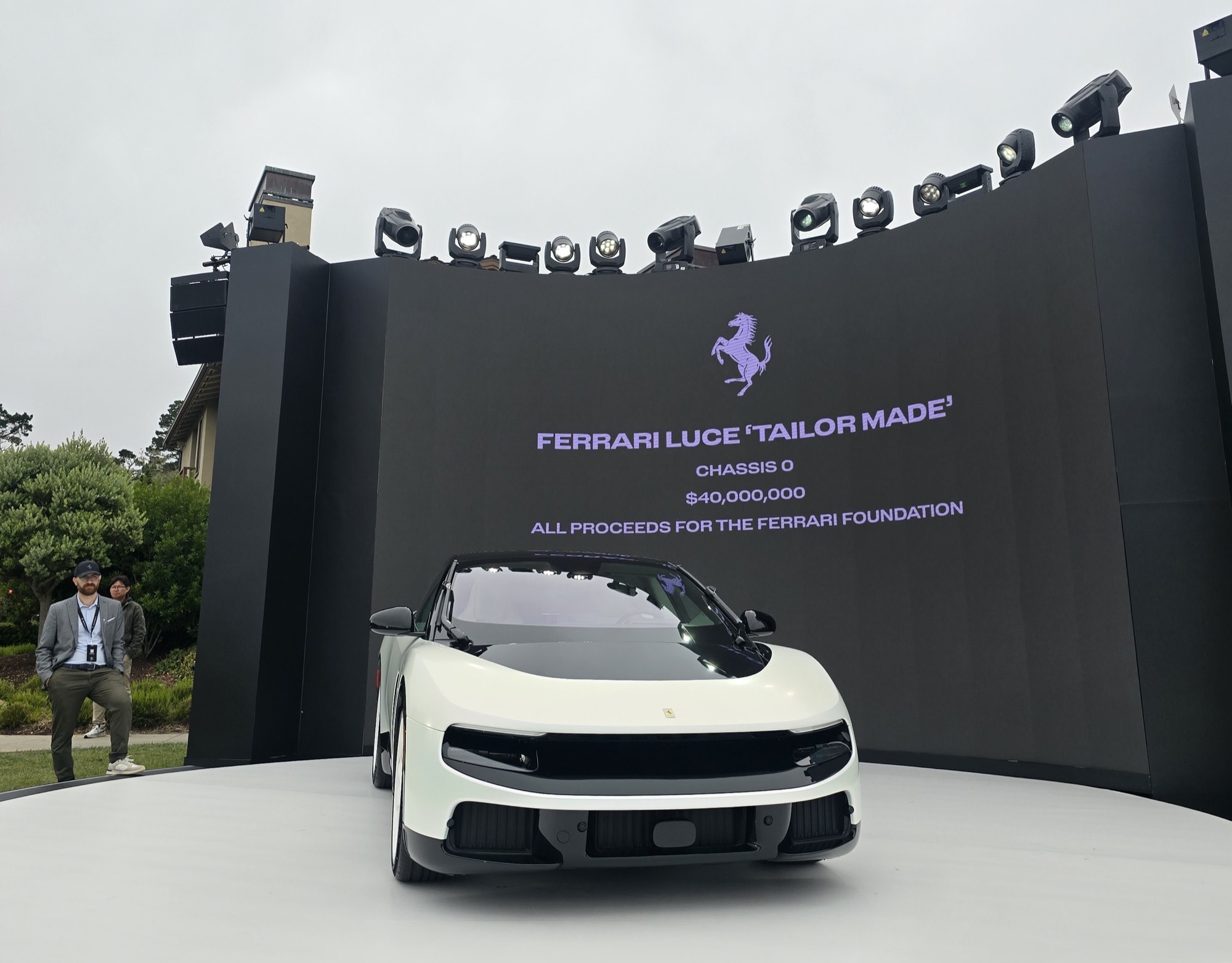
On a Saturday night during Monterey Car Week, RM Sotheby's sold Ferrari Luce Chassis 0 for $40 million. The car is the first production chassis of Ferrari's first series electric model, configured through Tailor Made and shown in Monterey with its Chassis 0 plaque and a screen that made the hammer price impossible to miss. A retail Luce starts in the mid-six-figures. The auction estimate sat around $1.1 million. Every dollar of the $40 million was pledged to educational work through the Ferrari Foundation.
The buyer, revealed after the sale, was Dr. Herbert "Herbie" Wertheim, the Miami optometrist, inventor, and investor Forbes has long called one of the best stock pickers most people have never heard of. He is 87. A year earlier, at the same charity format, he paid $26 million for a Tailor Made Ferrari Daytona SP3. The Luce bid was the sequel.
Stop at the sticker and the story is only spectacle. For diaspora households building wealth from ordinary paychecks, the useful part is the sequence that made a $40 million educational bid possible at all: master a craft, take product risk when you see a real gap, invest the surplus with patience, and leave room for luck.
Wertheim's craft started in the exam room. Born in 1939 to a working-class family that later lived above a Miami Beach bakery, he struggled with dyslexia, ran from an abusive home, and joined the U.S. Navy as a teenager after a truancy scrape. He studied physics and chemistry in service, later trained as an optometrist, and spent nights tinkering with lens chemistry. In the late 1960s he helped push ultraviolet-absorbing dyes for plastic eyeglass lenses into commercial use, work that fed the founding of Brain Power Incorporated in 1970. BPI grew into a global maker of optical tints, ophthalmic chemicals, and lab tools. If your glasses block UV, you are living inside the category he helped invent.
The early years were not yacht years. After he and Nicole married in 1969, they lived for a stretch on a modest houseboat on the Miami River, leopard-print walls and a Sears broom doing closet duty, while he left each morning for the optometry office and she kept the books. When a little cash appeared, they put a $2,000 down payment on a few acres in South Miami-Dade. The household habit showed up before the net worth did: keep living costs boring while the business and the portfolio get interesting.
Expertise that solves a concrete problem can out-earn a title. Wertheim did not get rich by collecting credentials for their own sake. He got paid because labs and sunglass makers needed chemistry that worked. For a first-gen professional, the practical version is to get unusually good at something the market already pays for: a specialty, a book of clients, a product line, a craft that compounds into raises, equity, or a small firm. How to Build Generational Wealth as a Child of Immigrants starts in that same place.
He also refused to treat BPI as a lifestyle brand to scale at any cost. He treated it as a cash engine and pointed the profits at public markets. That is a bet twice over: invent and sell something unproven, then refuse to let the cash sit idle. Many diaspora households reverse the order. They take career risk, then park surplus in cash or property alone because markets feel like gambling. Patient equity ownership carries its own risk, just a boring one measured in decades. Taxable Investing Basics for First-Gen Professionals and Taxable Brokerage Savings Rate Benchmarks for First-Gen Professionals are the practical versions of that habit.
What happened after the profits left the lab is the part most car-week coverage skips. Wertheim bought Apple at and after its 1980 IPO, Microsoft at its 1986 IPO, and began building a large HEICO stake in the early 1990s when the Hollywood, Florida aerospace-parts company was still a small, underloved name. The Mendelson family took operating control around 1990 and compounded the business for decades; Wertheim's patience turned a multimillion-dollar commitment into a fortune-defining position. Recent proxies still show him among the largest individual holders, with roughly 7.5 percent of the common and a similar slice of Class A. Forbes has lately pegged his wealth near $5 billion, mostly from that long compounding, not from a single product exit.
Luck still sits in the room. He came of age in a United States where a Navy stipend, public universities, plastic-lens adoption, and a fifty-year equity bull market could stack. He also had the temperament to hold through boredom and drawdowns, which is a skill and a privilege. Diaspora readers know the other side: visas that reset the clock, family wires that compete with 401(k) deferrals, parents who treat brokerage accounts as recklessness. Nobody needs Chassis 0 to copy the smaller version of the pattern: skill, surplus, ownership, time.
The auction itself is the piece that does not travel. Charity lots at Monterey price philanthropy, rarity, and theater together. A standard Luce allocation is not a $40 million asset, and confusing the two is how collectors get hurt. Wertheim's bid looks, in part, like a second-year charitable signature from someone who already proved the pattern with the Daytona SP3. The household takeaway sits upstream of the gavel: build cash flow from work you can defend, keep lifestyle drag low enough that surplus exists, and let ownership compound longer than your group chat's attention span.
Monday morning can stay plain. Get unusually good at one paid skill. Put a written cap on lifestyle and family support so surplus is real (Family Support Budget Calculator). Capture the employer match, then automate taxable investing at a rate you can sustain (First-Gen Retirement Planning Basics). When equity compensation lands, give the vest a job before it arrives (RSU Vest-Day Playbook for Diaspora Households). Then leave a line in the plan for luck: health, immigration timing, and which industry you happened to walk into.
Chassis 0 goes back to Maranello for final work and reaches a garage sometime in early 2027. By then the internet will have moved on to the next car. What lasts is the boring part of the record: a kid from above a bakery learned a trade, sold into a gap he found himself, held the proceeds for fifty years, and caught a favorable century. Only the last part was out of his hands.
Related content
Further diaspora reading
- Your cash looks ample until you run the family liquidity ratio (Generational)
- How to Build Generational Wealth as a Child of Immigrants (Generational)
- Taxable Investing Basics for First-Gen Professionals (Generational)
- RSU Vest-Day Playbook for Diaspora Households (Generational)
- Highs and Lows of Asian Multi-Generational Living (Goldsea)
Generational Take
Get the next Generational Take
Get our latest practical tips and takes in your inbox. No spam.